

Digital marketing is moving from disconnected tools toward systems that can interpret goals, generate creative variations, identify patterns and support optimisation. In 2026, these capabilities are appearing across advertising platforms and analytics products. The opportunity is real, but automation still needs human judgement over claims, budgets, customer experience and data quality.
This guide focuses on practical product developments and operating changes rather than another beginner's overview of SEO or social posting. It explains what newer AI marketing features can do, what they cannot do, how to prepare the data and creative they depend on, and how a small team can test them without handing over its entire marketing strategy.
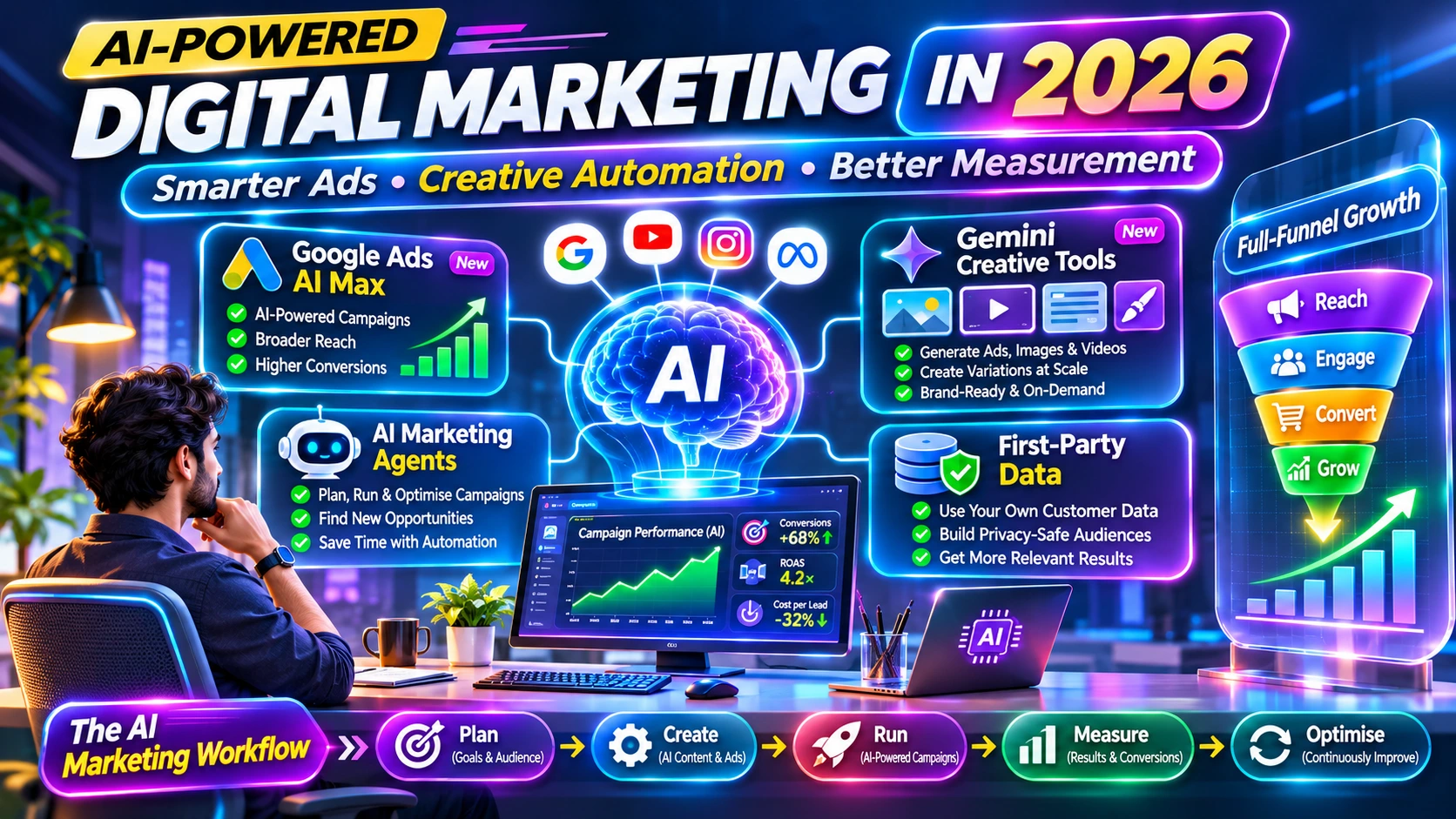
Use AI to accelerate research, generate controlled creative variations, identify patterns and support optimisation—not to replace campaign strategy. Start with reliable conversion tracking, accurate product and service information, clear brand and audience rules, and a small experiment. Compare outcomes against a baseline, check lead or sales quality, and expand only when the improvement is repeatable.
1. The new digital marketing operating model
Generate and adapt text, images and video from approved brand inputs.
Connect media activity with conversions, customer quality and business outcomes.
For a small business, the best model is a supervised operating loop: define the business objective, provide accurate inputs, let the platform assist, review its suggestions, run a controlled test and learn from the result. AI should make the loop faster and more informed—not make the business less accountable for what customers see.
2. Important AI marketing developments to know in 2026
Several platform updates illustrate where the market is moving. Availability can vary by account, country, campaign type and rollout stage, so check the current product interface and official documentation before planning a launch.
| Development | What it changes | Practical implication |
|---|---|---|
| Google Ads AI Max | AI-assisted search matching and creative capabilities, with additional controls and reporting | Review search coverage, brand controls, assets and landing-page destinations |
| AI Brief | Lets advertisers provide business, audience and messaging context in natural language in supported rollouts | Write precise instructions and exclusions before enabling automation |
| Gemini creative tools | Helps produce or adapt visual and video assets within advertising workflows | Build a reviewed asset library with usage rights and brand rules |
| Ask Advisor | AI assistance across Google marketing products for insights and possible actions | Use suggestions as decision support and verify the evidence |
| Measurement updates | More flexible conversion windows and stronger emphasis on first-party signals and incrementality | Align measurement settings with the real buying cycle |
These are examples of product direction, not a guarantee that every account has every feature. The practical response is to audit your existing setup, identify which updates are available to your account and test only the features that solve a real bottleneck.
3. Google Ads AI Max: more reach needs stronger guardrails
Prepare before enabling more automation
- Check that each important service or product has a relevant, current landing page.
- Maintain brand inclusions and exclusions where available and appropriate.
- Write messaging rules that explain approved claims, tone, offers and prohibited statements.
- Review search-term and landing-page reporting rather than judging the campaign only by clicks.
- Confirm conversion actions represent meaningful outcomes, not just low-value button clicks.
Google announced in August 2026 that it was introducing new testing and planning tools for AI Max, including ways to test budget and return-on-investment targets across multiple Search campaigns. These features reinforce a useful principle: do not scale because an AI system recommends more spend. Use experiments and unit economics to decide whether additional budget is justified.
Google's published developer guidance scheduled the second phase of Dynamic Search Ads migration to AI Max for February 2027. Advertisers using legacy campaign types should review the latest account notices and official migration guidance rather than assume every campaign has already changed.
Before a test, export or record the current campaign settings so you can compare the old and new configuration. Check whether automated text, search matching or final URL expansion is enabled, and inspect the pages the system may select. A campaign should not send a searcher looking for one specific service to a generic homepage if a more relevant page exists. Review exclusions and brand controls after launch, especially when the business serves a narrow category or has strict claims.
4. Creative automation: produce more variations without losing the brand
A practical creative testing matrix
| Variable | Variation A | Variation B |
|---|---|---|
| Customer problem | Save time | Reduce uncertainty |
| Proof point | Show the process | Show a real deliverable |
| Format | Short demonstration video | Carousel or static explainer |
| Call to action | Explore the service | Request a tailored discussion |
Change one meaningful variable at a time when the goal is to learn why one concept performs differently. Use a consistent offer and landing page where possible. Keep the strongest assets, remove inaccurate or weak versions and document what the test taught you about the audience.
Protect quality and rights
Review AI-created images for distorted products, misleading interfaces, incorrect logos and visual errors. Check music, stock, model and image licensing before publishing. Make sure generated testimonials, customer stories, certifications, product results or endorsements are never presented as real evidence. A human should approve the final asset and the destination it promotes.
Use a simple naming convention for each asset: audience, message angle, format and version. Store the original source file alongside the approved output, and note where an asset is allowed to run. This makes it easier to identify which creative actually produced a result and to replace outdated pricing, seasonal references or discontinued offers.
5. Demand Gen and video: connect discovery to action
Build a sequence rather than expecting one asset to do everything:
- Discovery: explain the problem or show a useful outcome in a short, engaging format.
- Consideration: provide a demonstration, comparison, customer question or detailed explanation.
- Action: make the offer, eligibility, next step and landing page clear.
- Follow-up: use consented audience data and platform-compliant settings to reconnect where appropriate.
Do not assume that a high video view count means a campaign is profitable. Evaluate the next action, the quality of traffic and the contribution to qualified enquiries or sales.
6. AI marketing agents: useful analysts, not unsupervised managers
Marketing platforms are beginning to embed AI agents that can help users investigate account performance, surface opportunities and move from questions to recommended actions. Google's Ask Advisor is an example of this direction across its marketing products. The value is not that an agent knows the business better than its owner; it can help a marketer navigate large sets of settings and data more efficiently.
Four areas to review before scaling
Set permission boundaries. Read-only analysis is a good starting point. Require human approval for budget changes, publishing, audience exports, account permissions, claims about results or customer communications. Keep an audit trail of what the agent suggested, what was accepted and what happened afterwards.
7. First-party data is the foundation of useful AI marketing
First-party data is information a business collects directly through its own customer relationships and digital properties, such as purchases, enquiries, subscriptions and service interactions. It is valuable because it can describe the business's actual customers and outcomes. It is also sensitive: collect only what is needed, explain how it is used, secure it and respect consent and applicable privacy requirements.
Build a clean measurement foundation
- Define what counts as a lead, qualified lead, booking, purchase and refund.
- Use consistent event names and prevent duplicate conversion recording.
- Connect offline outcomes where appropriate and lawful, using secure approved methods.
- Review consent, retention, access and data-sharing settings.
- Separate primary business outcomes from diagnostic events such as page views.
Google's 2026 measurement announcements emphasise stronger first-party data foundations and multiple measurement methods. That direction is important for small businesses too: a simple, accurate record of qualified enquiries and closed sales is often more valuable than a complicated dashboard built on inconsistent events.
For a lead-generation business, a useful data flow might record the enquiry, whether the contact was reachable, whether the requirement matched the service, whether a quote was issued and whether the work was won. You do not need to upload every customer detail to an ad platform. Keep sensitive operational records in the appropriate business system and share only the minimum permitted conversion information.
8. Conversion measurement: match the reporting window to the buying cycle
Choose a window based on the time customers realistically take to decide, the campaign objective and the reporting method. Document the setting and avoid comparing campaigns that use materially different attribution definitions without accounting for the difference.
Use more than one measurement lens
Shows how the ad platform attributes results within its own measurement model.
Helps understand on-site behaviour and conversion paths across channels.
Confirms which enquiries became qualified opportunities, customers and revenue.
For larger budgets, consider incrementality testing or marketing mix modelling when the business has enough data and expertise. These approaches ask a different question: what additional outcome occurred because the marketing activity ran? They complement attribution rather than replacing every other report.
For businesses with long sales cycles, create a simple weekly reconciliation between platform conversions and the CRM or order register. Investigate gaps such as duplicate leads, cancellations, unqualified enquiries and sales that close after the reporting window. This will not produce perfect attribution, but it prevents automated bidding decisions from relying entirely on an inflated conversion count.
9. A supervised AI marketing workflow for a small team
- Review sales and lead priorities.
- Choose one campaign objective.
- Confirm the offer and audience.
- Set a measurable baseline.
- Draft creative concepts with AI.
- Produce a small set of distinct assets.
- Review claims, brand and rights.
- Prepare matching landing pages.
- Launch a controlled experiment.
- Check tracking and lead quality.
- Review spend and delivery.
- Record decisions and next tests.
Keep the process proportionate. A local service provider may only need a few well-reviewed creative versions and a reliable enquiry report. An online retailer may need product-feed checks, product imagery, stock information and margin-aware conversion values. The right workflow depends on the business model.
Keep a short decision log: what changed, why it changed, who approved it, what result was expected and when it will be reviewed. A decision log prevents a team from repeating failed tests and helps a new marketer understand why a campaign uses a particular audience, message or budget limit.
10. Experiment design: prove that automation improves the business
Choose a primary outcome
Set guardrails
- Set a maximum test budget and duration appropriate to the campaign.
- Keep a control or baseline where the platform supports a valid comparison.
- Do not change creative, targeting, landing page and budget simultaneously unless the test is explicitly designed that way.
- Check lead quality, refund rates, sales conversion and customer complaints.
- Record the feature version, account eligibility and dates so the result can be interpreted later.
Automation can shift delivery and spend as it learns. Monitor early performance for tracking errors, policy issues and unexpected traffic, but avoid making daily changes based on tiny samples. Allow enough data to accumulate for a fair decision, while respecting the campaign's budget and risk limits.
11. Privacy, brand safety and human oversight
Human review checklist
- Is the claim accurate and supported by evidence?
- Does the creative represent the real product or service?
- Is the destination page relevant and working?
- Are targeting and data uses appropriate and permitted?
- Has someone authorised the budget and publishing action?
- Can the business explain why the campaign made a decision?
Responsible AI marketing is not about avoiding automation. It is about deciding which tasks can be delegated, which require approval and which should never be automated without a clear policy.
12. Common mistakes when adopting AI marketing tools
- Automating before tracking is reliable: fix conversion definitions and duplicate events first.
- Giving vague instructions: provide brand, audience, offer, exclusions and approval rules.
- Producing too many near-identical ads: test distinct customer propositions, not superficial wording changes.
- Scaling on cheap clicks: review qualified leads, sales and margin.
- Assuming AI recommendations are neutral: inspect the data, objective and constraints behind the suggestion.
- Ignoring landing-page quality: the best ad cannot rescue a confusing or broken destination.
- Publishing unverified claims: check every statistic, testimonial, product feature and promise.
- Removing human accountability: assign a named person to approve budgets, data access and public-facing creative.
The most expensive mistake is to confuse activity with progress. More assets, more automated recommendations and more dashboard alerts do not necessarily mean more customers. Keep the focus on the outcome the business actually needs.
13. A 90-day roadmap to adopt AI marketing responsibly
- Audit analytics and conversion events.
- Define qualified leads and sales outcomes.
- Document brand rules and approved claims.
- Review privacy and account permissions.
- Test one AI-assisted campaign feature.
- Create a small, distinct creative set.
- Use AI for bounded analysis tasks.
- Keep human approval for changes.
- Compare results with the baseline.
- Check quality and business value.
- Document repeatable workflows.
- Expand only where evidence supports it.
14. Check your AI marketing readiness
Use this interactive check to identify how many essential foundations are already in place. It is a planning aid, not a certification or a prediction of campaign results.
If the foundations are not ready, work on them before expanding automation. If they are ready, choose one use case with a clear owner and measurable outcome. Reassess after the test and update the workflow based on what actually happened.
15. Where TopRank Solution fits into a modern digital growth plan
When evaluating support, ask for a clear scope, the assets or pages involved, the reporting method and what is outside the provider's control. For paid media, confirm who owns the advertising account, how spend is billed and how conversions are measured. Keep platform media spend separate from service fees and make sure you retain access to your own accounts and data.
Connect your website, SEO and audience growth
Explore TopRank Solution's published services for AI-optimised website building, on-page SEO, contextual article links and YouTube and Instagram promotion. Choose a scope that supports your wider marketing plan.
Explore digital growth servicesService scope and deliverables should be confirmed before an order begins. Advertising and search outcomes are not guaranteed.Conclusion: use AI to improve decisions, not just output
Digital marketing in 2026 is becoming more assisted, more automated and more dependent on the quality of business data. AI Max, creative-generation tools, campaign advisors and more flexible measurement features can help teams discover opportunities and work faster. Their value depends on the strategy, information and safeguards provided by the business.
Official product updates and further reading
- Google: Evolve your marketing with new AI tools (August 10, 2026) — Ask Advisor and agentic experiences across Google Ads and Analytics.
- Google: New AI Max language and reporting features (September 23, 2026) — AI Brief and unified reporting announcements.
- Google: AI Max testing and planning tools (August 20, 2026) — campaign experiments and planning capabilities.
- Google: New data and measurement tools (September 10, 2026) — first-party data and measurement direction.
- Google Analytics release notes — conversion window and campaign data updates.
- Google Ads India announcements — check feature availability and regional rollout information.
Article by TopRank Solution Team
SEO, website development and practical digital growth.