

Blogger outreach in 2026 is no longer a matter of collecting thousands of email addresses, sending the same guest-post request to every website and judging success by a backlink count. Publishers receive more pitches than they can review, audiences expect useful and credible contributions, and search platforms continue to discourage link schemes that exist primarily to manipulate rankings. The campaigns that stand out are built around relevance, original expertise, editorial fit and relationships that can create value beyond a single placement.
Guest posting remains one format within a broader outreach strategy. A useful contribution can introduce a brand to a new audience, demonstrate subject knowledge, earn referral traffic, create publisher relationships and support digital PR. But the process requires more than submitting an article with a keyword-rich link. This guide explains how to plan a blogger outreach campaign, identify suitable publishers, evaluate opportunities, write personalized pitches, prepare guest posts, handle editorial requirements, understand sponsored-link disclosures and measure results responsibly.
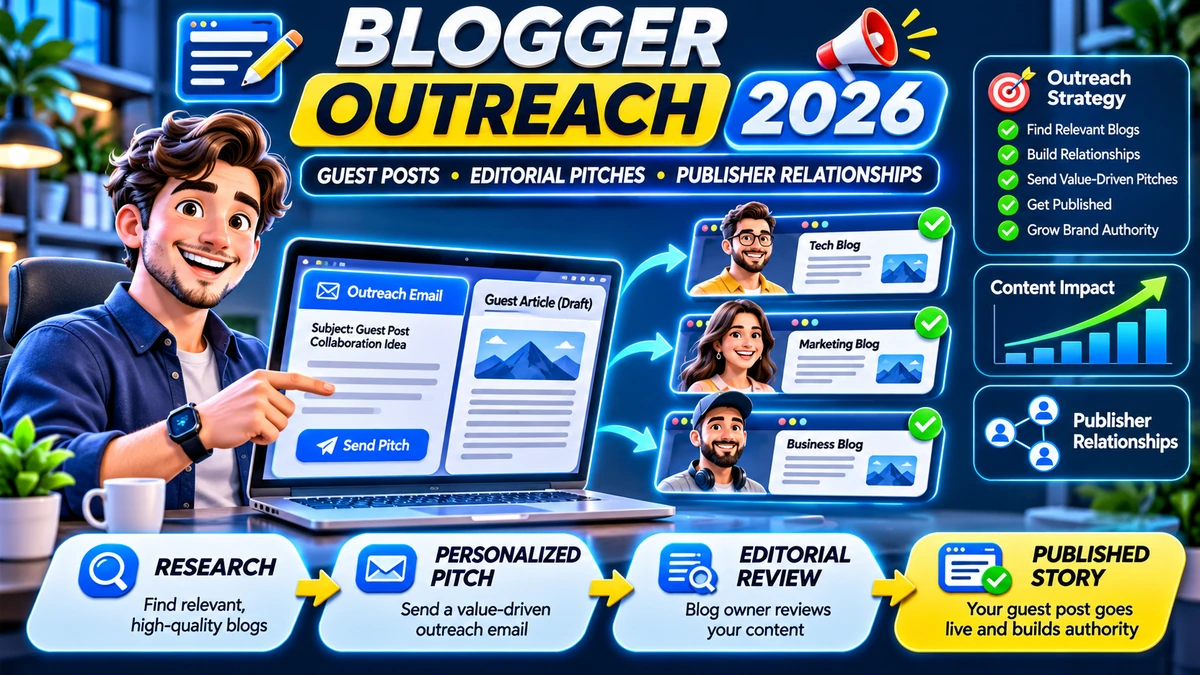
Effective blogger outreach starts by defining the audience and purpose of the campaign, finding publishers that genuinely cover the topic, checking editorial quality and readership, and pitching a specific idea that benefits that publication. Submit original work that follows the editor's guidelines, disclose commercial relationships where required, and qualify paid or sponsored links appropriately. Track replies, accepted pitches, publication quality, referral visits, engagement and business outcomes—not just the number of links or a third-party authority score. Use AI to support research and editing, not to mass-produce generic pitches or unreviewed articles.
From publisher research to published story
1. What is blogger outreach?
Blogger outreach is the process of building communication with bloggers, independent publishers, editors, creators and website owners to propose a collaboration that is relevant to their audience. Depending on the campaign, the outcome may be a guest article, expert quote, product review, interview, resource mention, original research feature, newsletter inclusion or another editorial collaboration.
The central idea is an exchange of value. The publisher receives useful information, a fresh perspective, credible expertise or content that serves its readers. The contributor gains an opportunity to share knowledge, build recognition and reach a relevant audience. A campaign becomes weak when the only intended benefit is placing a link on another domain.
Blogger outreach is used in digital marketing, public relations, content distribution, creator partnerships and relationship-led link acquisition. It can support brand awareness and referral traffic even when a placement does not provide a followed backlink. That distinction matters: a good editorial relationship should not be judged only by whether a link passes ranking credit.
2. What is guest posting and how is it different from blogger outreach?
Guest posting, also called guest blogging or contributor publishing, is one specific form of blogger outreach. A writer or organization contributes an article to a publication that it does not own. The publisher reviews the submission and decides whether to edit, accept, schedule and publish it.
Blogger outreach is broader. It may involve proposing an article, offering expert commentary, contributing data to a journalist, requesting an interview, sharing a useful resource or developing a long-term content partnership. Guest posting is therefore a tactic inside an outreach program, not the entire strategy.
| Activity | What it involves | Typical objective |
|---|---|---|
| Guest post submission | Pitching and writing an original article for another publication | Reach a relevant readership and demonstrate expertise |
| Expert commentary | Providing a specialist quote or explanation for an existing story | Earn credible coverage and authority |
| Digital PR outreach | Sharing research, news, data or a story angle with media contacts | Editorial coverage and brand visibility |
| Creator collaboration | Working with a blogger or creator on content or a campaign | Audience engagement and product awareness |
| Resource contribution | Suggesting a genuinely useful tool, guide or reference for a relevant page | Help readers discover a useful resource |
Choose the format that matches the publisher and the campaign objective. A publication that rarely accepts guest articles may still welcome a concise expert comment or original dataset. Do not force every outreach opportunity into a guest-post request.
3. How blogger outreach is changing in 2026
Outreach has become more competitive because publishers face crowded inboxes, AI-assisted submissions and limited editorial capacity. A generic email with a broad topic suggestion is easy to ignore. Editors need to understand quickly why the idea belongs on their site, why the contributor is qualified and what readers will gain.
At the same time, search quality guidance places emphasis on the purpose and quality of content and links. Google's spam policies identify manipulative link practices, including paid links intended to pass ranking credit, automated link creation and large-scale guest-post campaigns whose primary purpose is link building. Google does not prohibit useful contributor articles simply because they are guest posts; the risk is a campaign designed mainly to manipulate ranking signals rather than serve readers.
Three practical shifts define a stronger 2026 approach:
- From volume to fit: prioritize publications with a real topical connection and an audience likely to care about the contribution.
- From link placement to editorial value: develop original ideas, practical examples, credible sources and useful explanations.
- From one-off emails to relationships: learn what editors cover, follow submission rules and become a reliable source over time.
AI tools can help map topics, organize prospects and improve clarity, but they do not replace editorial judgment. Sending thousands of lightly personalized messages or generating interchangeable articles at scale is not a durable strategy.
4. Set clear goals before contacting publishers
Start by defining what the campaign should achieve. A campaign aimed at brand awareness may prioritize publications with an engaged readership. A campaign focused on qualified leads may seek niche blogs whose readers have a specific business problem. A digital PR campaign may prioritize editorial credibility and coverage rather than a conventional guest article.
Write down one primary objective and two or three supporting measures. Examples include:
- Introduce a new service to a clearly defined industry audience.
- Build recognition for a subject-matter expert or company founder.
- Generate relevant referral visits to a useful resource or service page.
- Earn editorial coverage for original research or a practical industry analysis.
- Develop relationships with publishers for future interviews, commentary or collaborations.
Avoid setting the objective as “get 100 backlinks” without defining relevance, quality or business value. That target can reward poor placements and encourage excessive outreach. A smaller number of well-matched editorial contributions may be more valuable than a large list of unrelated publications.
5. Define the audience and topic territory
Before searching for blogs, define the people you want to reach. Consider their role, industry, experience level, questions, problems and preferred content formats. A guest article for startup founders should not use the same angle as a tutorial for software developers or a practical guide for local business owners.
Next, map the topics your brand can credibly discuss. Include areas where your team has direct experience, original data, practical processes, customer insights or specialist knowledge. Do not pitch a medical, financial or legal topic simply because a keyword appears attractive if the contributor lacks the necessary expertise and review process.
Build a topic matrix with three columns: the audience question, the useful insight you can contribute and the type of publication likely to serve that reader. This creates a reason for each prospect to receive a specific pitch instead of sending the same subject to every site.
6. How to find blogs that accept guest posts
Prospecting should combine search research, competitor and industry discovery, publication directories and manual review. Search operators can reveal public submission pages, but a result appearing in Google does not prove that a site currently accepts guest articles or that it is a good fit.
Useful search patterns include:
"write for us" + [your topic]
"guest post guidelines" + [your industry]
"contribute an article" + [your topic]
"become a contributor" + [your niche]
"submit an article" + [your subject]
[publication name] + editorial guidelines
[topic] + "guest author"
Use these queries to discover potential publishers, then inspect each website. Check its current editorial pages, recent articles, author profiles, publication dates and contact route. Some sites use terms such as “contributors,” “submissions,” “pitch us” or “editorial policy” instead of “write for us.”
Other discovery methods include following industry newsletters, identifying the publications cited by respected experts, reviewing conference and association blogs, exploring podcast and creator networks, and noting which editors regularly cover your topic. Search for actual editorial relevance, not only pages that advertise guest-post opportunities.
7. Build a structured blogger outreach prospect list
Record potential publishers in a spreadsheet or CRM before sending emails. A structured list prevents duplicate outreach, helps prioritize opportunities and preserves context about previous conversations.
| Field | What to record |
|---|---|
| Publication | Blog or publisher name and website |
| Topic fit | Relevant categories and recent articles |
| Audience | Who the publication appears to serve |
| Editorial contact | Named editor, contributor manager or published contact route |
| Submission rules | Accepted formats, pitch requirements and content restrictions |
| Quality notes | Originality, author transparency, content standards and update frequency |
| Campaign angle | The specific idea proposed for this publisher |
| Status | Researching, ready to pitch, sent, replied, accepted, submitted, published or closed |
| Follow-up date | Next appropriate contact date, if follow-up is permitted |
Keep the list focused. A prospect should not be added merely because its domain has a high authority score or because it has a “write for us” page. Record why the site is relevant and what its readers could gain from your contribution.
8. How to evaluate a blog before submitting a guest post
Publisher evaluation is more important than collecting a large number of prospects. Review the site as a reader would. Does it publish meaningful content? Are the articles written for a clear audience? Do authors have credible profiles? Are the topics consistent? Does the site appear to maintain editorial standards?
Use a practical quality review:
- Topical relevance: does the publication regularly cover the subject you want to pitch?
- Audience alignment: are its readers likely to benefit from your expertise or resource?
- Editorial quality: are articles well-structured, fact-checked and meaningfully edited?
- Author transparency: are contributor names, biographies and credentials visible where appropriate?
- Publication activity: does the site publish consistently and maintain older material?
- Reader experience: are pages readable, navigable and not overwhelmed by intrusive ads or unrelated outbound links?
- Reputation: does the publication have a credible presence in its industry or community?
- Submission transparency: are the editorial process, commercial options and contact details clear?
Third-party metrics such as Domain Rating (DR), Domain Authority (DA), estimated traffic and backlink counts can be used as supplementary research signals. They are not Google metrics and do not prove that a publication has genuine readership, editorial credibility or ranking value. A smaller specialist publication can be a better audience match than a much larger general blog.
9. Red flags that indicate a low-quality guest-post opportunity
Some websites exist mainly to sell article placements or host large volumes of unrelated content. A site may advertise instant publication, guaranteed followed links, exact-match anchor text or bulk packages without meaningful editorial review. These are warning signs that deserve investigation.
- Unrelated industries appear together with no coherent editorial purpose.
- Every article contains commercial links to unrelated websites.
- The publisher promises ranking improvements or guaranteed PageRank transfer.
- There is no identifiable editor, author policy or genuine contact information.
- Content appears duplicated, thin, automatically rewritten or rarely edited.
- The site sells followed links while refusing to disclose sponsored content.
- Publication is guaranteed regardless of article quality or relevance.
- The publisher insists on keyword-stuffed anchors or excessive exact-match links.
Do not assume every site with a commercial contributor program is automatically poor quality. Some legitimate publishers sell advertising or sponsored content transparently. The key is to understand what is being purchased, how the relationship is disclosed and how links are qualified. Paid exposure should not be represented as an independent editorial endorsement.
10. Match your guest-post idea to the publication
A good topic is not automatically a good pitch. Editors need an angle that fits their existing coverage without repeating an article they published last month. Read recent posts and look for a useful gap: a new development, a practical implementation problem, a comparison readers need, a case study or a question that existing articles have not fully answered.
For example, a general marketing blog may have covered “What is SEO?” many times. A more useful contribution could examine how a small team evaluates AI-generated search visibility reports, how to measure referral quality from niche communities or how to build a privacy-conscious analytics workflow. The angle should be specific enough that the editor can imagine the finished article.
Before pitching, write a one-sentence promise: “After reading this article, the publication's audience will be able to…” If the sentence is vague, the idea needs more work.
11. How to write a blogger outreach email that gets considered
A strong outreach email is concise, relevant and easy to evaluate. It should show that you know the publication, explain the proposed value and make the next step simple. Avoid exaggerated praise, generic introductions and claims that the article will “boost SEO” for the publisher.
A practical pitch structure is:
- Subject: describe the topic or collaboration clearly.
- Personal opening: mention a specific recent article, editorial theme or audience need.
- Credibility: briefly explain why you or the proposed author can contribute.
- Pitch: offer one focused headline and a short explanation of the reader benefit.
- Evidence: mention original research, experience, examples or a useful resource where relevant.
- Next step: ask whether the editor would like a short outline or full draft.
Do not attach a large article without checking the publisher's submission rules. Some editors prefer a short pitch; others request a complete draft. Follow the stated process instead of assuming every publication works the same way.
12. Blogger outreach email template for a guest-post pitch
Use the following as a starting point and personalize it for the publication. Do not send it unchanged to a large list.
Subject: Guest article idea for [Publication]: [Specific topic]
Hi [Editor's name],
I read your recent article on [specific subject] and noticed your publication regularly covers [relevant topic] for [audience]. I have an idea that could extend that coverage with a practical angle.
I'd like to propose an original article titled “[Proposed headline].” It would cover [two or three useful points] and give readers [specific takeaway]. I can support it with [relevant experience, examples or original data].
If the topic fits your upcoming editorial calendar, would you prefer a short outline or a complete draft? I'm happy to follow your contributor guidelines.
Best,
[Your name]
[Role / organization]
[Relevant profile or work sample]
Keep the email accurate. Do not claim to have read an article if you have not. Do not invent credentials, audience statistics or research findings. A short, honest pitch is stronger than an elaborate message filled with generic compliments.
13. Personalize outreach without making it complicated
Personalization is not simply inserting a first name, publication name and a sentence generated from the homepage. Useful personalization demonstrates a real understanding of the publication's content and readers.
Before contacting an editor, note one recent relevant article, the audience question it addresses and a logical next topic. Reference the article naturally and explain how your proposed contribution adds something different. If the publication has detailed contributor rules, show that you have read them by following the requested format.
Use a few meaningful details rather than a long paragraph of praise. Avoid referencing irrelevant personal information or social activity. Outreach should feel professional and respectful, not intrusive.
14. How to use AI in blogger outreach in 2026
AI can make research and workflow management more efficient, but it should support human judgment rather than replace it. Useful applications include clustering publication topics, summarizing public submission requirements, organizing prospect notes, checking an email for clarity, generating alternative headline ideas and identifying questions that an article should answer.
A responsible AI-assisted workflow looks like this:
- Use research tools to discover potential publishers, then manually verify each website and its current editorial policy.
- Ask AI to summarize a publication's public topic categories, then check the source pages yourself.
- Use AI to brainstorm several article angles, but select one based on genuine audience fit and original insight.
- Draft an email with AI assistance, then add accurate details from your own review of the publication.
- Use editorial tools for grammar and structure, while a knowledgeable author verifies facts, examples and claims.
- Keep a human approval step before sending messages or submitting content.
Do not scrape private contact information, fabricate personalization, generate fake author identities or send mass messages that ignore publisher preferences. Do not publish unreviewed AI-generated articles across many sites simply to create links. Google's guidance says generative AI can help with research and structure, but producing many low-value pages to manipulate search is inconsistent with its scaled content abuse policy. Read Google's guidance on generative AI content.
15. When and how to follow up with an editor
Editors have competing deadlines, so silence does not always mean rejection. However, repeated follow-ups can damage a relationship. First check whether the publication states a response window or asks contributors not to follow up. If no rule is provided, one polite follow-up after a reasonable interval—often around five to seven business days—is a practical starting point, not a universal requirement.
A useful follow-up is brief and includes the original topic so the editor does not need to search for context. Ask whether the idea is relevant to the editorial calendar and make it easy for them to decline. If there is no response after a further reasonable interval, close the prospect and move on rather than sending repeated reminders.
Do not follow up through multiple channels at once unless the editor has invited that communication. Respect unsubscribe requests, opt-outs and applicable email marketing and privacy rules.
16. Read guest-post submission guidelines carefully
Each publisher may have different requirements for article length, format, images, citations, author bios, links, exclusivity and review timelines. Some accept only pitches; some want a complete draft; others invite experts to contribute to a defined series. Read the current instructions before preparing the submission.
Record the requirements in your prospect sheet. If a rule is unclear, ask one concise question before submitting. Do not ignore word limits, insert promotional links against policy or send an article that has already been published elsewhere when the editor requests original work.
Common requirements include:
- Accepted topics and prohibited subjects.
- Preferred headline and outline format.
- Word-count range and formatting style.
- Originality and plagiarism expectations.
- Evidence, citations and source standards.
- Image dimensions, rights and attribution.
- Author biography and profile requirements.
- Rules for links, self-promotion and commercial disclosure.
- Whether simultaneous submissions or republishing are allowed.
17. How to write a guest post editors actually want to publish
Write for the publication's audience, not as an advertisement for your own business. A useful guest article answers a real question, offers a clear argument or teaches a practical process. It should have a focused headline, logical sections, examples, accurate references and a conclusion that helps the reader take the next step.
Before drafting, create an outline with the main question, reader level, key sections, evidence needed and intended takeaway. Use examples that make the advice concrete. If you refer to research, link to the original source and represent its findings accurately. If you share a case study, explain the context and limitations rather than presenting an exceptional result as a universal outcome.
Remove unnecessary sales language. A guest article should not repeatedly mention the contributor's company, insert unrelated service links or use exact-match commercial anchors unnaturally. Include a short author bio only if the publisher allows it and keep it factual.
18. Originality, expertise and editorial trust
Editors receive many articles that repeat familiar advice. Originality does not always require a new scientific discovery. It can come from a useful framework, a first-hand implementation, a carefully explained failure, a comparison based on transparent criteria, a dataset or a perspective that the publication has not covered.
Show the author's connection to the subject. Include relevant experience, explain the method behind any analysis and distinguish observed results from opinion. If the article touches on high-impact topics such as health, finance or legal matters, use appropriate expertise and review.
Do not fabricate surveys, client outcomes, quotes, screenshots or statistics to make a pitch more attractive. If you do not have original data, use credible public sources and offer a practical interpretation instead. Trust is built through accuracy and transparency, not through inflated claims.
19. Guest-post links, anchor text and Google's link policies
Links can help readers discover related sources, tools and further explanations. In a guest article, include a link only when it is useful in context and permitted by the publisher. A relevant citation to a genuinely helpful resource is different from inserting a commercial link solely to influence search rankings.
Google's spam policies identify buying or selling links for ranking purposes, automated link creation, excessive link exchanges and large-scale article campaigns with optimized anchor text as examples of link spam. Google's guidance also explains that useful contributor articles are not inherently discouraged; the problem is publishing primarily to build links at scale.
For paid placements, advertisements or sponsored content, links should be appropriately qualified. Google's link qualification guidance recommends rel="sponsored" for advertisements and paid placements. rel="nofollow" remains an acceptable alternative for qualifying such links. User-generated links may use rel="ugc" where appropriate.
<!-- Paid or sponsored placement -->
<a href="https://example.com/resource"
   rel="sponsored">Useful resource</a>

<!-- Editorial citation, when independently chosen -->
<a href="https://example.com/research">
  Original research
</a>
Do not negotiate a paid followed link as a guaranteed SEO outcome. Publishers should retain editorial control and disclose commercial relationships in line with applicable laws and platform policies. Review Google's official documentation before agreeing to link terms: Qualify outbound links for Google and Google Search spam policies.
20. Editorial guest posts vs paid sponsored posts
These formats can look similar on a page, but the relationship behind them is different. An editorial guest contribution is accepted because an editor believes the content is suitable for readers. A sponsored article is a commercial placement in which payment or another material benefit is part of the arrangement.
| Factor | Editorial contribution | Sponsored placement |
|---|---|---|
| Selection | Publisher evaluates topic and editorial merit | Publisher offers a paid or commercial opportunity |
| Disclosure | Follow publisher policy and disclose relevant conflicts | Clearly disclose the commercial relationship where required |
| Link treatment | Publisher decides editorial links independently | Paid links should be qualified appropriately |
| Primary value | Reader value, expertise and editorial coverage | Paid exposure, distribution and audience access |
| Measurement | Engagement, referral visits, coverage and relationships | Reach, qualified traffic, engagement and campaign outcomes |
Neither format should be misrepresented. If a placement is paid, do not describe it as an independent editorial endorsement. A sponsored article can still be useful to readers when it is transparent, relevant and clearly produced for the publication's audience.
21. How to discuss fees, editorial control and publication terms
Some publishers accept unpaid expert contributions, while others charge for sponsored content, production or distribution. Ask what the fee covers and whether the opportunity is editorial, sponsored or a different commercial product. Clarify the expected disclosure, link attributes, content review, publication date, update policy and whether the publisher can edit or decline the article.
Do not pay for a promise that a link will pass ranking credit or improve a specific keyword position. If the objective is paid reach, evaluate the placement as advertising: audience relevance, visibility, expected distribution, content quality and measurable outcomes. Make sure the commercial terms are written down and approved by the appropriate people.
Publishers should retain the right to edit content for accuracy, style and audience fit. Contributors should retain clarity about factual changes, attribution, image rights and any reuse restrictions. Agree on these points before work begins.
22. What to do after your guest post is published
Publication is not the end of the relationship. Review the live article to confirm that the headline, author information, citations, images and disclosures are accurate. Check that links work and that the article appears as agreed. If there is a factual error, contact the editor politely with the exact correction and supporting source.
Share the article through relevant company channels, newsletters or professional communities where appropriate. Do not spam unrelated groups or misrepresent the publisher's endorsement. Respond constructively to reader questions if the publication permits author participation.
Record the publication URL, date, topic, author, link treatment, referral tracking details and any agreed update or removal terms. Thank the editor and keep a note of future topics that may suit the publication. A useful contribution can become the beginning of a longer professional relationship.
23. How to measure blogger outreach campaign performance
Measure the campaign against its original objective. If the goal is brand exposure, track publication reach where reliable data is available, referral visits, branded search interest and engagement. If the goal is qualified leads, use campaign-specific landing pages or UTM parameters where appropriate and monitor meaningful conversions. If the goal is expert visibility, track invitations, mentions and future editorial requests.
| Metric | What it tells you | How to interpret it |
|---|---|---|
| Qualified prospects | How many researched publishers fit the campaign | Measures prospecting quality, not final results |
| Positive reply rate | Share of contacted editors who show interest | Review by pitch angle and publisher segment |
| Pitch acceptance rate | Share of proposed ideas accepted | Indicates topic fit and pitch strength |
| Publication rate | Accepted contributions that go live | Shows delivery and editorial completion |
| Referral sessions | Visits arriving from the published article | Review engagement and source relevance |
| Assisted conversions | Conversions influenced by referral exposure | Use attribution carefully; do not assume last-click tells the whole story |
| Relationship growth | Repeat invitations, expert requests and ongoing collaborations | Measures longer-term publisher value |
Do not use Domain Authority or Domain Rating as the only success measure. These are third-party metrics and do not directly represent Google's evaluation of a page. A campaign report should explain what was published, who it reached, how readers interacted and whether the contribution supported the intended business outcome.
24. A practical blogger outreach workflow
- Define the audience and campaign goal.
- Find relevant blogs and publishers.
- Review editorial quality and guidelines.
- Record contact and topic notes.
- Choose a publication-specific angle.
- Write a concise personalized email.
- Share author credentials and evidence.
- Follow the publisher's contact rules.
- Prepare an original article or outline.
- Verify claims, links and citations.
- Follow word count and formatting rules.
- Revise based on editorial feedback.
- Review the live article and disclosures.
- Promote it to relevant audiences.
- Measure traffic and engagement.
- Maintain the publisher relationship.
25. Organize outreach with a CRM or campaign tracker
When a campaign involves multiple publishers, a structured tracker prevents repeated pitches and missed editorial requirements. A simple spreadsheet may be enough for a small campaign. Larger programs may use a CRM or outreach platform with contact history, task reminders, email integration and reporting.
Use consistent stages such as Researching, Qualified, Pitch Ready, Contacted, Replied, Outline Requested, Draft Submitted, Revision, Accepted, Published and Closed. Store the last contact date and next action. Keep notes factual and relevant; do not store sensitive personal information that is unnecessary for the business relationship.
Review campaign performance by publication category, topic angle and outreach method. If a particular angle receives positive replies from relevant editors, develop it further. If a segment consistently rejects pitches, revisit the audience fit or value proposition rather than increasing message volume.
26. Common blogger outreach and guest-post mistakes
- Sending identical emails: generic outreach gives editors little reason to respond.
- Pitching unrelated sites: a high authority score does not make a publication relevant.
- Leading with backlinks: editors are responsible for their readers, not your link targets.
- Ignoring submission guidelines: the wrong format or topic can lead to immediate rejection.
- Submitting thin or duplicated articles: content needs a clear purpose and original value.
- Overusing exact-match anchors: unnatural commercial linking can create policy risks.
- Buying undisclosed followed links: paid links intended to pass ranking credit violate Google's link spam policies.
- Using AI without review: fabricated facts and interchangeable content damage credibility.
- Following up repeatedly: excessive reminders can harm publisher relationships.
- Ignoring post-publication checks: errors, broken links or missing disclosures may go unnoticed.
- Reporting only link counts: campaign value includes readership, engagement, coverage and relationships.
27. A 30-day blogger outreach campaign plan
- Define the audience and campaign objective.
- Map credible topics and article angles.
- Find a focused list of relevant publishers.
- Review quality and submission rules.
- Prioritize the best-fit prospects.
- Research editors and recent coverage.
- Prepare publication-specific ideas.
- Write concise, personalized pitches.
- Collect author profiles and work samples.
- Send a carefully reviewed first batch.
- Respond to interested editors.
- Prepare outlines or full drafts as requested.
- Verify sources, examples and claims.
- Apply editorial feedback.
- Confirm disclosure and link treatment.
- Review live placements for accuracy.
- Share published work with relevant audiences.
- Record referral and engagement data.
- Thank editors and plan future ideas.
- Improve the next outreach cycle.
This is a starting framework, not a promise that publishers will accept or publish an article within 30 days. Editorial calendars, review queues and publication schedules vary. Prioritize quality and follow each publisher's process.
28. How to plan a blogger outreach budget
Campaign costs depend on the amount of research, writing, editing, tools, design, expert review and distribution required. An unpaid editorial contribution may still require significant staff time. A sponsored placement has a different cost structure and should be evaluated as paid media rather than treated as a guaranteed SEO investment.
Separate the budget into prospect research, outreach operations, content creation, expert review, creative assets, paid distribution where applicable and measurement. Track staff time as well as direct expenses. This helps compare campaign formats fairly and prevents a low placement fee from hiding substantial production costs.
Do not choose a publisher solely because it offers the cheapest article placement. Evaluate the audience, editorial quality, disclosure, distribution and likely business value. If the publisher cannot explain what the fee covers, request clarification before committing.
29. Blogger outreach campaign readiness assessment
Use this quick assessment to check whether the main foundations of your campaign are in place. It is a planning aid, not a prediction of acceptance or SEO performance.
The five foundations are: clear campaign goals, qualified publishers, relevant pitch ideas, original content and a measurement process.
30. How professional blogger outreach supports digital marketing
Well-planned outreach connects a business with publications and communities that already serve its target audience. A useful contribution can explain a complex subject, introduce a practical solution, add expert context to an industry discussion or share research that readers would not otherwise discover. These outcomes support brand visibility and can create meaningful referral paths.
For digital marketing teams, blogger outreach works best alongside content strategy, digital PR, social distribution and relationship management. It should not be isolated as a monthly link quota. The strongest campaigns begin with a useful idea and a credible contributor, then identify publishers for whom that idea is genuinely relevant.
TopRank Solution provides SEO, content and digital growth services. Blogger outreach and guest-post planning can be part of a broader marketing program when publisher selection, content quality, commercial disclosure and campaign measurement are handled transparently. The focus should remain on reaching relevant readers and building durable brand visibility.
Build a smarter digital outreach strategy
Explore SEO, content marketing and digital growth services from TopRank Solution. Plan relevant publisher outreach, useful content and measurable audience development.
Explore digital marketing servicesDefine your audience, editorial standards, disclosure requirements and campaign objectives before starting outreach.31. Frequently asked questions about blogger outreach and guest posting
What is blogger outreach in digital marketing?
Blogger outreach is the process of contacting relevant bloggers, editors and publishers to propose a useful collaboration. It may involve guest articles, expert comments, interviews, reviews, research contributions or other editorial opportunities.
Is guest posting still effective in 2026?
Guest posting can support audience reach, expertise and referral traffic when the article is relevant and genuinely useful to the host publication. It should not be used as a large-scale method to manipulate rankings through keyword-rich links. Editorial quality and audience fit matter more than placement volume.
What is the difference between blogger outreach and guest posting?
Blogger outreach is the broader relationship-building process. Guest posting is one tactic within it, where a contributor writes an article for another publisher. Outreach can also lead to interviews, expert quotes, product coverage and digital PR.
How do I find blogs that accept guest posts?
Search for contributor guidelines, write-for-us pages, editorial submission pages and relevant industry publications. Review each site's recent content, audience, author standards and contact instructions before pitching. A public submission page does not automatically mean the site is a suitable publisher.
How do I write a guest-post pitch email?
Use a clear subject, a specific reference to the publication, one focused article idea, a short explanation of reader value, relevant author credentials and a simple next step. Follow the editor's stated submission process and personalize the message honestly.
How many follow-ups should I send?
Follow the publisher's stated policy. If no policy exists, one polite follow-up after a reasonable interval is often sufficient. If there is still no response, close the prospect rather than sending repeated reminders.
Should I pay for guest-post placements?
Some publishers sell sponsored content or advertising. Evaluate these as commercial placements, clarify disclosure and editorial terms, and ensure paid links are qualified appropriately. Do not pay for a promise of followed ranking credit.
What is the difference between sponsored and editorial links?
An editorial link is selected independently because it helps readers. A paid or sponsored placement involves a commercial relationship and should be qualified with an appropriate link attribute such as rel="sponsored"; rel="nofollow" is also acceptable for paid links under Google's guidance.
Does blogger outreach improve SEO?
Outreach may support discovery, brand visibility, relevant referral traffic and editorial coverage. A link obtained through a manipulative scheme is not a safe SEO strategy. Focus on useful content, legitimate relationships and compliant link treatment rather than guaranteed ranking outcomes.
Can AI write blogger outreach emails?
AI can help brainstorm angles, organize research and improve email clarity. A human should verify the publication details, author credentials and proposed value. Avoid mass-generated messages that pretend to be personal or ignore publisher preferences.
What should a guest post include?
A strong guest post has a clear reader-focused headline, useful introduction, logical sections, original insight, accurate sources, practical examples and a concise conclusion. It should follow the host publisher's style and submission rules.
How do I measure a blogger outreach campaign?
Track qualified prospects, positive replies, accepted pitches, published contributions, referral sessions, reader engagement, assisted conversions and repeat editorial relationships. Interpret each metric in relation to the campaign's original objective.
Conclusion: make blogger outreach about relationships and reader value
Blogger outreach and guest-post submission can play a useful role in digital marketing when they are based on relevance, original ideas and genuine publisher relationships. The process starts with a clear audience and campaign goal, continues through careful prospect research and personalized pitching, and succeeds when the submitted article meets the publication's editorial standards.
In 2026, avoid treating outreach as a numbers game. Do not mass-submit generic articles, purchase undisclosed ranking links or judge every opportunity by a third-party authority score. Use AI to support research and workflow, keep human review at the center, disclose commercial relationships and measure outcomes that matter to readers and the business.
A well-chosen publication and a genuinely useful contribution can create value long after the article goes live. Build fewer, better relationships—and make every submission worth publishing.
Official guidelines and useful resources
- Google Search Central: Spam Policies — current guidance on link spam and other manipulative practices.
- Google Search Central: Qualify Outbound Links — when and how to use sponsored, nofollow and UGC link attributes.
- Google Search Central: A Reminder About Links in Large-Scale Article Campaigns — guidance on contributor and guest-post campaigns.
- Google Search Central: Guidance on Generative AI Content — quality, originality and scaled content considerations.
- Google Search Central: Qualifying Links and Link Spam — background on commercial link qualification.
Article by TopRank Solution Team
SEO, content marketing and digital growth.