A Facebook Page can collect views without building a useful audience, or gain followers who rarely interact with its posts. Sustainable promotion needs more than a bigger number beneath the Page name. It requires a clear reason to follow, content that earns attention, distribution to the right people, and a measurement system that connects reach and video views with meaningful actions such as enquiries, visits, bookings or sales.
This guide explains how to promote a Facebook Page to increase relevant followers and video views in 2026. It covers Page setup, Reels and video strategy, organic distribution, Meta advertising, audience targeting, creative testing, analytics, campaign budgeting, common mistakes and a practical 30-day action plan. The recommendations are designed for small businesses, creators, local brands and service providers that want real audience development rather than artificial engagement.
To grow a Facebook Page, make the Page useful and complete, publish original content consistently, use Reels and videos to reach new viewers, participate in relevant communities without spamming, invite genuine customers to follow, and test Meta ads with a defined audience and objective. Track reach, meaningful video views, watch time, follows attributed to content or campaigns, engagement quality and business outcomes. Avoid buying fake followers or views: inflated numbers do not create a reliable audience and can put Page distribution and account standing at risk.
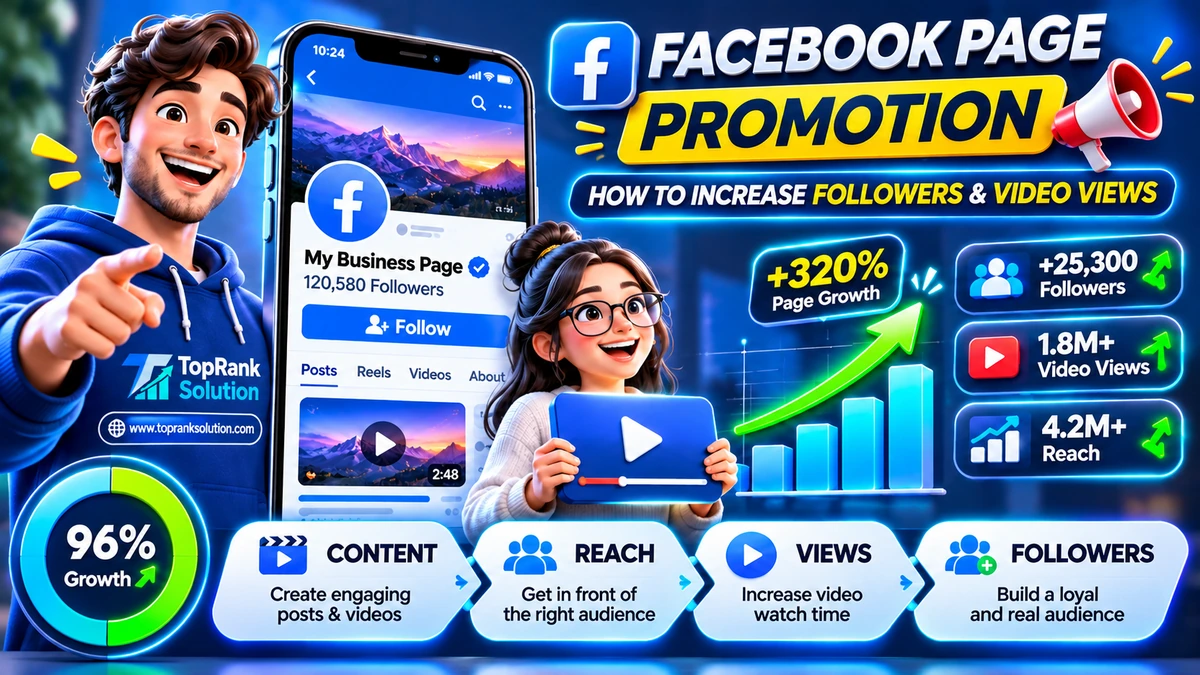
Four foundations of a stronger Facebook Page
1. What Facebook Page promotion actually means
Facebook Page promotion is the planned process of making a business or creator Page visible to people who are likely to care about its content, products or services. It can include organic publishing, short-form video, community participation, collaborations, customer recommendations and paid advertising through Meta's advertising tools.
There are several outcomes that are often grouped together but should be measured separately:
- Reach: the number of people or accounts that saw content, according to the definition shown in the relevant Meta insight.
- Views or plays: video consumption events. The exact counting definition can vary by format and reporting surface, so use the metric description shown in the current dashboard.
- Watch time and retention: how long people continue watching and where they stop.
- Followers: people who choose to follow the Page and may receive or discover its future content.
- Engagement: meaningful reactions, comments, shares, saves where available, clicks and conversations.
- Business results: qualified enquiries, website visits, calls, bookings, purchases or repeat customers.
These numbers are connected, but they are not interchangeable. A video can receive many views and very few follows. A Page can gain followers but generate little traffic. A smaller audience can produce more valuable enquiries if it closely matches the business's target market. The right promotion plan begins by deciding which outcome matters most.
2. Set a clear goal before promoting the Page
Do not start by selecting a follower target without considering the business objective. A local restaurant may need nearby people to discover its menu and opening hours. A software company may want product demonstrations watched by decision-makers. A creator may care about repeat viewers and community participation. These Pages should not use the same content or advertising strategy.
| Primary goal | Useful content | Metrics to monitor |
|---|---|---|
| Increase relevant followers | Recurring series, helpful tips, clear Page identity | New follows, follows by content, unfollows, audience fit |
| Increase video views | Reels, demonstrations, explainers, stories | Plays/views, watch time, retention, shares |
| Generate enquiries | Case explanations, FAQs, service walkthroughs, proof | Messages, lead forms, calls, qualified leads |
| Drive website traffic | Product explainers, useful articles, offers with context | Outbound clicks, landing-page sessions, conversions |
| Build local awareness | Local stories, customer questions, events and updates | Local reach, profile actions, directions, calls |
Choose one primary objective for each campaign and one or two supporting metrics. For example, a video-view campaign can use watch time and audience retention as quality checks, while a Page-growth campaign can measure new followers and the proportion who match the intended audience. This prevents a campaign from being declared successful just because one large number increased.
3. Optimize the Facebook Page before sending traffic to it
Promotion magnifies the first impression. If someone clicks an advert or discovers a Reel and lands on an incomplete Page, the opportunity may be wasted. Before spending money or posting at high volume, make it immediately clear who the Page represents, what it offers and why someone should follow it.
Complete the essential Page details
- Use a recognizable profile image, usually a clean logo or creator identity that remains legible at small sizes.
- Create a cover image that communicates the brand, product, service or current priority without crowding it with tiny text.
- Choose the most accurate Page category and write a concise description using natural customer language.
- Add the correct website, contact details, location and business hours where relevant.
- Set an appropriate action button, such as contacting the business, booking, shopping or visiting the website, depending on the options available to the Page.
- Review messaging settings and decide how enquiries will be handled.
- Pin or feature a useful introduction, popular resource or current announcement when the Page interface supports it.
- Check that recent posts represent the quality and tone you want new visitors to expect.
Check the Page as a visitor on both mobile and desktop. Confirm that the logo is not cropped, the cover image is readable, links work and the latest posts are relevant. A promotion campaign should send people to a destination that is ready to convert attention into a follow, conversation or next step.
4. Define the audience you actually want to attract
Audience definition is more important than broad exposure. Start with customer characteristics that influence whether a person is likely to value the Page: location, interests, needs, profession, buying situation, language and the problems they are trying to solve. Avoid describing an audience only as “everyone who uses Facebook”.
For a local service business, geography may be the first filter. For a specialist B2B company, job role and business context may matter more. For a creator, the audience may be defined by the subject matter and the questions viewers repeatedly ask. Write down the audience's main problem, what information they need before taking action and what would make them return to the Page.
Use existing customer insight
Review the questions customers ask in calls, messages, reviews and sales conversations. Look at which posts already generate useful comments or shares. If the Page has enough data, examine audience insights and content performance in Meta's current professional tools. Use these observations to develop content themes and advertising hypotheses rather than assuming a platform interest label perfectly describes a person.
When building paid audiences, follow the targeting options and restrictions available in the current Ads Manager. Do not use sensitive personal information or attempt to infer protected characteristics. Keep targeting relevant to the offer and comply with applicable advertising rules.
5. Build content pillars that give people a reason to follow
People rarely follow a Page because it posts randomly. They follow because they expect future content to be useful, entertaining, informative or relevant. Content pillars create that expectation and make publishing easier to plan.
Short tutorials, practical tips, checklists and answers to recurring questions.
Product walkthroughs, before-and-after explanations and process videos.
Behind-the-scenes updates, team stories, customer perspectives and local moments.
A balanced Page might use four or five recurring pillars:
- Educational content: explain a problem and show a practical way to approach it.
- Product or service demonstrations: show what the offer does, who it helps and what the process looks like.
- Trust-building content: answer objections, explain policies, introduce the team and share authentic customer feedback with permission.
- Community content: ask relevant questions, respond to local topics and invite useful discussion.
- Timely updates: announce launches, seasonal information, events or changes that genuinely matter to the audience.
Make each post useful on its own. Do not force every post to sell. A Page that repeatedly provides value earns more reasons for people to remember it and return.
6. Use Facebook Reels to reach new viewers
Short-form video can introduce a Page to people who do not already follow it. Reels are particularly useful for demonstrating a product, explaining one idea, showing a process or presenting a concise story. A Reel should deliver its main point quickly and make sense even when a viewer has never heard of the business.
A practical Reel structure
- Opening hook: begin with the problem, result, question or visual demonstration. Avoid long introductions.
- Context: tell viewers what they are about to learn or see.
- Value: demonstrate the tip, explain the process or show the product in use.
- Payoff: provide the answer or outcome promised by the opening.
- Relevant next step: invite viewers to follow for more useful content, ask a genuine question or visit the relevant page.
Keep the video focused. Use clear audio, readable on-screen text and captions where appropriate. Make sure important text is not hidden behind interface controls. Use vertical framing when the format calls for it, and check the finished video on a phone before publishing.
Originality matters. Repackage an idea in your own voice, examples and visuals rather than repeatedly reposting copied clips or adding superficial edits to someone else's work. Use music, footage and images that you have the rights to use. If a topic needs more explanation, create a series of short videos instead of squeezing too much information into one clip.
Measure more than the view count
Review watch time, average viewing duration, retention patterns, shares, comments and follows attributed to the Reel when those insights are available. A video with fewer views but stronger retention and more relevant follows may be more valuable than a high-view clip that attracts people who have no interest in the Page's subject.
7. How to increase Facebook video views without misleading viewers
More video views begin with a stronger match between the video and the people who see it. A compelling opening may earn the first few seconds, but the video must then deliver what it promised. Misleading thumbnails, unrelated captions and exaggerated claims can create a short burst of curiosity while damaging trust and retention.
- Choose one specific viewer problem or question for each video.
- Show the most interesting demonstration early rather than hiding it behind a long intro.
- Use a descriptive title or caption that accurately reflects the content.
- Keep the editing pace appropriate to the subject; speed is not a substitute for clarity.
- Add captions or on-screen labels so the message remains understandable without sound.
- Share the video with a relevant audience, not indiscriminately across unrelated groups.
- Turn strong topics into follow-up videos that answer the next question.
- Review retention data and improve the section where viewers commonly leave.
Do not buy views from bots, use automated viewing networks or arrange deceptive engagement exchanges. Artificial views do not represent people choosing to watch and can distort performance data. Meta has publicly described enforcement against spammy distribution and coordinated fake engagement, including measures that can reduce reach or affect monetization eligibility.
8. Organic ways to increase Facebook Page followers
Organic growth is built by making the Page discoverable and giving people a reason to follow voluntarily. It may take longer than a paid campaign, but it can create a more durable audience when the content consistently serves a clear interest.
Use these practical methods
- Invite genuine customers and contacts: use Page invitation features appropriately and avoid repeatedly pressuring people who are not interested.
- Share useful posts from the business website: add context so the Facebook post has value even before someone clicks through.
- Participate in relevant groups: answer questions helpfully and follow each group's rules. Do not paste repetitive promotional links into unrelated discussions.
- Collaborate with complementary Pages: work with creators, local organizations or businesses whose audiences have a genuine reason to care about your content.
- Make the Page visible offline: include the Page name or a suitable QR code on receipts, packaging, event materials or in-store displays where it is useful.
- Cross-promote thoughtfully: tell existing email subscribers or website visitors what kind of useful Facebook content they can expect.
- Respond to comments: answer questions and acknowledge contributions so visitors see an active, approachable Page.
- Create recurring series: a weekly tip, product demonstration or local update gives people a reason to return.
Do not treat every group as an advertising channel. Read the rules, contribute to the conversation and share a Page post only when it directly answers the discussion and promotion is permitted. Repeated unsolicited posting can damage the brand's reputation and may be treated as spam.
9. Use Meta ads to promote posts, videos and Page discovery
Paid promotion can accelerate distribution when the Page has a clear offer and useful creative. Meta's advertising system changes over time, and campaign objectives and interface labels can vary by account, region and product updates. Choose the objective that matches the outcome you need in the current Ads Manager rather than relying on an old tutorial's button names.
Depending on the current account setup, relevant campaign approaches may include awareness or reach for visibility, engagement or video-view optimization for content consumption, and traffic or lead-focused campaigns when the goal is a website visit or enquiry. If your priority is Page follows, verify which Page-growth or engagement options are currently available in the account and assess the actual follow results; do not assume a video-view campaign will automatically produce followers.
Build a campaign around one outcome
- Choose the business goal: decide whether the campaign should introduce the brand, generate qualified video views, encourage Page discovery or produce leads.
- Select the audience: use relevant location, broad or interest-based approaches as appropriate and permitted by current platform controls.
- Choose a suitable creative: use a short demonstration, clear benefit, customer question or compelling educational video.
- Write accurate copy: explain what the viewer will receive and avoid guaranteed results or unsupported claims.
- Set a test budget: begin with an amount the business can afford to learn from, then compare results before scaling.
- Measure the right action: review the campaign objective alongside follows, watch time, messages, landing-page behaviour or leads.
Boosting an existing post can be a convenient way to distribute content, but it is not automatically the best choice for every campaign. Ads Manager generally offers more control over campaign structure, testing and reporting. Choose the simplest setup that allows you to measure the result you actually need.
10. Facebook audience targeting: reach people likely to care
Targeting should reflect the customer and the offer. A neighbourhood business may need a practical radius around its service area. A national ecommerce brand may need broader geographic coverage. A specialist creator may test audiences around a topic, while a business with enough first-party data may use permitted custom or similar audience options available in the platform.
Start with a simple audience hypothesis and avoid making too many narrow assumptions. Very small audiences can restrict delivery or make results unstable. Very broad audiences can waste budget when the creative and offer are not clear. Test one meaningful audience difference at a time so the results are interpretable.
Respect Meta's special ad category rules and restrictions where applicable. Do not target or exclude people using sensitive personal attributes, and do not upload contact data unless the business has the required rights and notices. Follow applicable privacy and advertising laws in every market targeted.
11. Test creative formats, hooks and calls to action
Creative is often the most visible part of a promotion campaign. Test different ways of communicating the same genuine value: a talking-head explanation, a product demonstration, a customer question, a step-by-step visual or a short story. Keep the offer and audience reasonably consistent when comparing creative so you can understand what changed the result.
| Creative format | Useful for | What to test |
|---|---|---|
| Short vertical video | Discovery, demonstrations and quick tips | Opening hook, length, retention, follows |
| Carousel or multi-image post | Step-by-step explanations and product options | First frame, sequence, saves and clicks |
| Single image | Clear announcements or simple offers | Visual hierarchy, message and action |
| Customer story | Trust and proof, with permission | Specificity, authenticity and enquiries |
| Live or longer video | Demonstrations, events and detailed questions | Attendance, watch time and follow-up actions |
Use a clear call to action, but make it appropriate. “Follow for weekly maintenance tips” tells the viewer what future value to expect. “Send us your question” invites a conversation. “View the full guide” directs interested people to a deeper resource. Avoid engagement bait that asks for meaningless reactions or comments unrelated to the content.
12. A realistic weekly Facebook content calendar
Consistency is easier when the Page has a repeatable schedule. The right posting frequency depends on the team's capacity and the audience's response. A small business should not publish several weak posts every day just to hit a volume target. Start with a schedule that can be maintained and improve it using performance data.
| Day | Example content | Purpose |
|---|---|---|
| Monday | One useful tip or common question | Education and saves |
| Tuesday | Short Reel showing a process | Discovery and video views |
| Wednesday | Customer FAQ or product explanation | Trust and consideration |
| Thursday | Behind-the-scenes or team update | Brand connection |
| Friday | Case example or customer story | Proof and enquiries |
| Weekend | Community question, event or timely update | Conversation and relevance |
This is a planning example, not a rule imposed by Facebook. Use the Page's own audience activity and content results to adjust timing and frequency. Leave room to respond to comments and messages; publishing without community management makes the Page feel one-way.
13. Measure Facebook Page growth, video views and campaign quality
Use the current Meta Business Suite and Page insights available to the account to understand content and audience performance. Interface names and metric definitions can change, so read the descriptions in the reporting view and compare like with like. Separate organic and paid results where the dashboard allows it.
Build a simple weekly scorecard
- Distribution: reach or impressions, using the metric definition shown in the report.
- Video quality: plays or views, average watch time, retention and completion where available.
- Audience development: new follows, unfollows and follows attributed to particular content or campaigns where reported.
- Engagement quality: comments that show genuine interest, shares, meaningful reactions and message conversations.
- Traffic: link clicks, landing-page visits and useful on-site actions.
- Business impact: qualified leads, bookings, sales or other outcomes that matter to the organization.
- Efficiency: spend per relevant result, cost per qualified lead or cost per acquired customer where measurement is reliable.
Do not compare a three-second video view with a longer intentional watch as if they represent equal attention. Do not compare paid and organic reach without noting the distribution method. Document the reporting period, campaign objective, creative and audience so that the team can understand why performance changed.
14. How much should you spend on Facebook Page promotion?
There is no universal budget that guarantees a certain number of followers or views. Costs vary by market, audience, competition, creative, objective, season and account setup. A budget that works for one local business may be unsuitable for another.
Set a learning budget based on what the business can afford to spend without depending on an uncertain return. Run a controlled test long enough to gather useful evidence, but monitor delivery and policy status. Avoid making major decisions from a handful of impressions or changing multiple variables every few hours.
When results are promising, increase spend gradually and watch whether cost and quality remain stable. A campaign that generates cheap views but no relevant audience or business actions may not deserve more budget. A smaller campaign that produces qualified conversations may be more valuable.
Track total campaign cost, creative production time and any landing-page or follow-up costs. Promotion is a system: the ad earns attention, the Page establishes trust, and the next step turns interest into an outcome. If the Page is incomplete or messages go unanswered, increasing the ad budget may simply send more people into a weak experience.
15. Use AI tools to plan and improve Facebook content
AI can help a small team develop content ideas, outline short videos, repurpose long-form material, draft captions, generate subtitles and organize a publishing calendar. It is most useful as an assistant to human judgment, not as a substitute for original knowledge or customer understanding.
- Turn frequently asked customer questions into a list of Reel topics.
- Draft several opening hooks and choose the one that accurately reflects the video.
- Convert a detailed tutorial into a short script, carousel outline and FAQ post.
- Generate caption variations for testing while keeping claims consistent.
- Summarize performance reports and identify posts that deserve a follow-up.
- Build a content calendar around launches, seasonal events and customer needs.
Review every AI-assisted output before publishing. Check facts, product details, prices, names, permissions, image rights and tone. Avoid publishing repetitive generic posts at scale. Meta has stated that it is reducing distribution of spammy and unoriginal content patterns; quality and originality should remain central to the workflow.
16. Why buying fake Facebook followers and views is a bad strategy
Services promising instant followers, guaranteed views or automated reactions can be tempting when a Page is new. However, a large number is not the same as an interested audience. Fake or low-quality accounts may never watch the next video, ask about a product or become customers. They can distort analytics and make it harder to understand what genuine people value.
Meta has publicly described actions against fake Pages, scripted follows, coordinated fake engagement and spammy distribution. Its April 2025 update also explained that accounts using spam tactics to game distribution may receive reduced reach or lose monetization eligibility. This makes artificial inflation a poor foundation for a business Page.
Be cautious of providers that ask for Page passwords, request administrator access without a clear operational need, promise guaranteed viral results or cannot explain their audience acquisition method. Never share login codes or give broad account permissions to an unknown vendor. Use official business access controls and grant only the permissions required for legitimate work.
Legitimate promotion means distributing real content to people who may find it useful, through transparent organic activity, compliant partnerships and official advertising tools. It does not mean manufacturing reactions or pretending that a Page is more popular than it is.
17. Common Facebook promotion mistakes to avoid
- Chasing followers without a content plan: people need a reason to stay after following.
- Optimizing only for views: high view counts may not translate into audience growth or business value.
- Using unrelated hashtags and captions: misleading context weakens trust and can look spammy.
- Posting copied or low-effort content: repeated unoriginal material gives audiences little reason to return.
- Promoting an incomplete Page: new visitors may leave when the offer, contact details or recent activity are unclear.
- Targeting everyone: broad exposure is not useful if the audience cannot become a customer or engaged follower.
- Changing too many campaign variables: it becomes difficult to identify what caused the result.
- Ignoring comments and messages: promotion creates conversations that need a timely response.
- Buying fake followers or views: artificial metrics do not create a trustworthy audience.
- Failing to track outcomes: without a scorecard, the team cannot distinguish attention from results.
18. A 30-day Facebook Page promotion plan
- Complete the Page profile, cover and description.
- Set the correct action button and contact details.
- Define one primary audience and business goal.
- Choose three to five content pillars.
- Record the starting follower and content metrics.
- Publish a small set of useful posts and original Reels.
- Test different hooks and video structures.
- Reply to comments and genuine questions.
- Share relevant content in communities where allowed.
- Review watch time, retention and follows.
- Select one campaign outcome.
- Test two or three creative variations.
- Use an audience that fits the offer.
- Monitor spend, delivery and quality.
- Pause weak creative and document findings.
- Make follow-up content from the strongest topics.
- Compare organic and paid results separately.
- Review new followers and business actions.
- Improve the Page based on visitor questions.
- Plan the next month around evidence.
At the end of the month, do not judge success only by the difference in follower count. Ask whether the Page attracted the right people, whether video viewers stayed to watch, whether the audience interacted and whether any meaningful business actions followed. Use those findings to decide what to repeat, improve or stop.
19. Facebook Page promotion readiness check
Before launching a campaign, confirm that the basics are in place. Use this assessment to identify what still needs attention.
The five foundations are: complete Page, defined audience, repeatable content pillars, measurement setup and a tested promotion plan.
20. Turn Facebook attention into measurable business value
Follower growth and video views are useful indicators, but a business Page should connect them to a wider customer journey. A viewer may watch a product demonstration, visit the Page, read customer feedback, click the website and contact the business days later. Attribution is not always perfect, especially when people switch devices or return through another channel, so combine platform reporting with website analytics and a consistent lead-recording process.
Use clear landing pages and campaign links where appropriate. Make sure the website works well on mobile, the offer matches the ad, and contact forms or messaging routes are functioning. Ask new enquiries how they discovered the business when that information is useful and collected responsibly.
Review the quality of leads, not just their volume. If a campaign produces many enquiries but few are relevant, revisit the creative, audience, offer and landing page. If video viewers are interested but do not follow, make the Page's ongoing value clearer. If followers increase but reach later declines, examine content relevance and audience response rather than immediately buying more distribution.
21. Professional social media promotion for business growth
Consistent Facebook promotion requires content planning, creative production, audience understanding, campaign setup and performance review. Businesses that do not have an in-house team may need structured support to coordinate these activities and maintain a reliable publishing process.
TopRank Solution provides social media promotion alongside website development, SEO and digital growth services. A practical promotion plan should begin with the business objective, the audience, the content assets and the reporting method. It should also explain whether the work involves organic publishing, official paid advertising, creative support or analytics—and which tasks are included in the agreed scope.
When evaluating a promotion provider, ask how audiences are reached, whether advertising is run through official tools, how account access is handled, what reporting is supplied and how results are defined. Avoid providers that guarantee a fixed number of followers or views without explaining the source and quality of the audience.
Promote your social presence with a clear growth strategy
Explore social media promotion services from TopRank Solution, alongside website development and SEO support. Build a plan around relevant audiences, useful content and measurable campaign outcomes.
Explore social media marketing servicesConfirm the platforms, deliverables, audience approach, advertising budget and reporting before a campaign begins.22. Frequently asked questions about Facebook Page promotion
How can I increase followers on my Facebook Page?
Complete the Page profile, publish useful original content, create recurring Reels or post series, invite genuine customers where appropriate, participate in relevant communities and test official Meta advertising options. Track whether new followers match the audience you want to reach.
How can I get more views on Facebook videos?
Start with a clear hook, deliver the promised value quickly, use readable captions, choose a topic your audience cares about and review retention data. Share videos with relevant communities and test paid distribution when it supports a defined goal.
Does boosting a Facebook post increase followers?
Boosting can increase distribution and may lead to Page visits or follows, but the outcome depends on the creative, audience, campaign setup and the reason people have to follow. Monitor actual follows and their quality rather than assuming every additional view becomes a follower.
Should I buy Facebook followers?
No. Purchased or automated followers may be fake, irrelevant or inactive. They do not create a dependable customer base and can undermine reporting. Use authentic content, relevant partnerships and official advertising tools instead.
How often should a business post on Facebook?
There is no universal ideal frequency. Choose a schedule your team can maintain while producing useful content and responding to the audience. Review results and adjust based on the Page's own performance.
Are Facebook video views and reach the same?
No. Reach describes how many people or accounts were exposed to content under the metric definition, while video views or plays describe video consumption events. Read the definitions in the current reporting interface before comparing results.
Can a small business grow a Facebook Page without ads?
Yes. Organic growth can come from original content, helpful Reels, customer recommendations, community participation, collaborations and cross-promotion. Paid advertising can extend distribution, but it is not a substitute for a useful Page.
How long does Facebook Page growth take?
There is no fixed timeline. Growth depends on the audience, niche, content quality, consistency, distribution and competition. Use a 30-day test to establish a baseline and learn which content earns relevant attention; continue improving over a longer period.
Conclusion: build a real Facebook audience, not just a bigger number
Effective Facebook Page promotion combines a clear Page identity, original content, relevant distribution and disciplined measurement. Reels can introduce the Page to new viewers, useful posts can give people a reason to follow, and official advertising tools can help distribute content to a defined audience. But every tactic should support a real objective.
Measure reach, video views, watch time, follows, engagement quality and business outcomes separately. Improve the content based on what people actually watch and respond to. Avoid fake followers, artificial views and spammy distribution. A smaller audience that trusts the Page and takes meaningful action is more valuable than an inflated number that never returns.
Official resources and further reading
- Meta: Cracking Down on Spammy Content on Facebook — platform guidance on spammy distribution and fake engagement enforcement.
- Meta for Business: Ads — official advertising tools and campaign information.
- Meta Business Suite — tools for managing business presence and content.
- Meta Business Help Centre — current help articles for Pages, advertising and insights.
- Meta Transparency Centre: Inauthentic Behaviour — policy information about deceptive and inauthentic activity.
Article by TopRank Solution Team
Social media marketing, website development and practical digital growth.