
Backlinks still matter in SEO, but the way successful teams earn them is changing. In 2026, a credible link profile is not simply a spreadsheet of domains, authority scores and anchor text. It is the result of being useful enough to reference: publishing original evidence, earning editorial coverage, building topical recognition and making a brand consistently understandable across the web.
This guide explains how to build high-quality backlinks in 2026 without relying on bulk link packages, automated placements or outdated exchange schemes. It connects traditional link earning with digital PR, unlinked brand mentions, topical relevance and the changing discovery environment around AI-generated search answers. You will learn how to assess a link opportunity, create assets publishers want to cite, run outreach, measure results and build a repeatable process for a business website.
Build high-quality backlinks by creating something worth citing, identifying publications and websites that genuinely cover your subject, and pitching a specific editorial reason to reference it. Prioritize relevance, editorial independence, real readership and context over raw link counts or third-party authority scores. Use digital PR, original research, expert commentary, useful tools and genuine partnerships. Avoid buying followed links, automated link schemes, excessive exchanges and low-value guest-post networks. Track referring domains, link relevance, earned mentions, target-page performance and qualified referral traffic—not just the number of new backlinks.
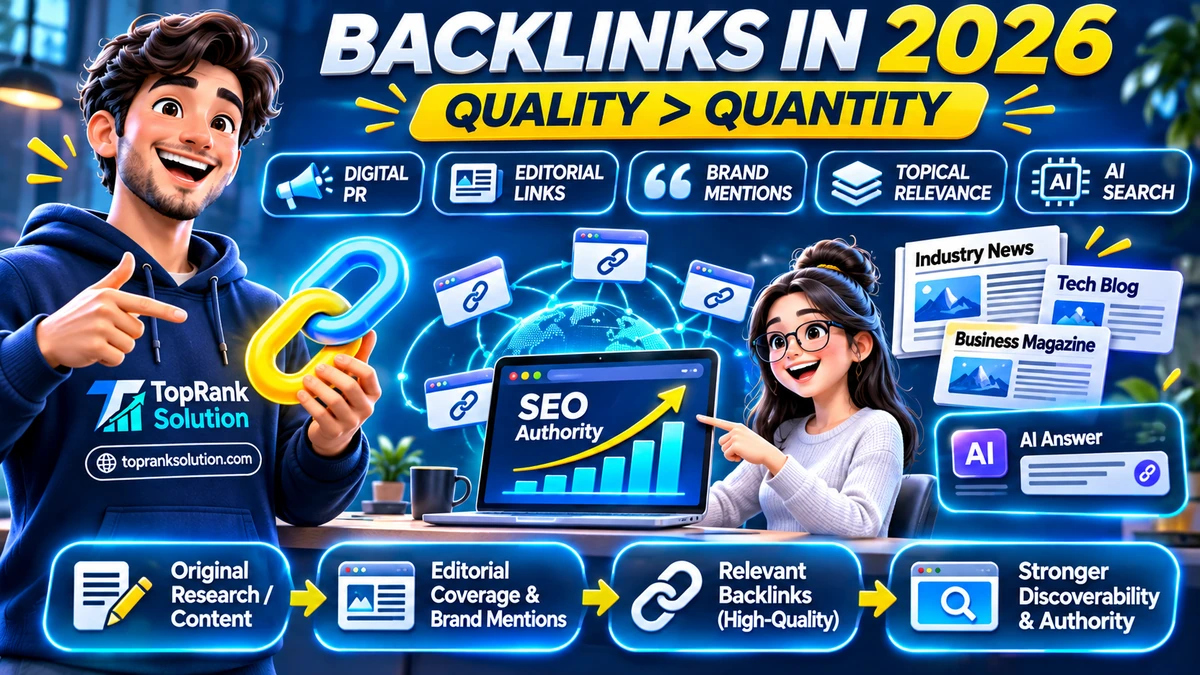
Four stages of a stronger backlink strategy
1. Backlinks in 2026: what has changed?
A backlink is a link from another website to a page on your website. Search engines can use links to discover pages and understand relationships between documents. Links may also act as signals of relevance and prominence. But a backlink is not a guaranteed ranking boost, and every link does not carry the same meaning or value.
The most important change in 2026 is not that links have disappeared. It is that link volume is an increasingly incomplete way to describe authority. A link from a relevant editorial article can be useful because it places a business in context, introduces it to readers and provides a reference to a resource. A thousand repeated links from unrelated pages may add little value and can create risk if they exist primarily to manipulate rankings.
At the same time, search discovery is no longer limited to ten blue links. AI Overviews, AI Mode and other answer experiences create additional visibility surfaces. Brands need content that can be independently understood and cited, not merely a high numerical score in a backlink tool. A strong strategy therefore combines editorial links with useful on-site information, recognizable expertise and a consistent brand footprint.
2. What 2026 link-building research tells us
Recent industry surveys provide a useful snapshot of how practitioners are adapting. They are not Google's ranking-factor documentation, and their findings should not be interpreted as proof that a particular tactic causes rankings or AI citations. They do, however, show where experienced practitioners are investing time and attention.
| 2026 research finding | Reported result | What it suggests |
|---|---|---|
| Digital PR named the best-performing link-building method | 34% in Reporter Outreach's survey of 500 SEO professionals | Original stories and editorial coverage are central to many modern campaigns. |
| Respondents who increased link-building budgets versus 2025 | 58% in the same survey | Many teams continue to fund authority and reputation work. |
| Respondents who believe backlinks affect AI search visibility | 74% in the same survey | Practitioner belief is widespread, but belief is not proof of causation. |
| Respondents actively tracking backlink impact on AI visibility | 24% in the same survey | Measurement is still immature; teams should define their own baseline. |
Reporter Outreach describes a survey of 500 SEO professionals conducted in Q1 2026. Another 2026 survey from Editorial.Link sampled 518 SEO professionals and examined budgets, tactics and AI-search perceptions. These are industry surveys with their own sampling methods, not representative measurements of all websites.
A separate analysis reported by Search Engine Land discussed an Ahrefs study of 75,000 brands and correlations with Google AI Overview brand mentions. In that analysis, branded web mentions showed a stronger correlation with AI Overview mentions than raw backlink count. The reported correlation values included 0.664 for branded web mentions, 0.527 for branded anchor text, 0.326 for Domain Rating and 0.218 for total backlinks. Correlation does not establish that mentions or links caused the AI citations, but the pattern is a useful reason to stop treating raw link count as the whole strategy.
The practical takeaway is to build a recognizable brand and publish pages that contain specific, useful information. Links remain part of the picture, but editorial context, brand references and the quality of the destination deserve more attention than a single authority metric.
3. What makes a backlink high quality?
There is no single public score that determines whether a backlink is high quality. Third-party tools estimate link authority in different ways, and their metrics are not Google metrics. Evaluate the actual page, publisher, context and reason the link exists.
The linking page and publication have a genuine connection to your subject, audience or industry.
The link is included because it supports a useful article, source, explanation or recommendation.
The publisher has identifiable readers and the placement can create discovery or referral value.
Use these questions when assessing a potential link:
- Would the page still make sense if search engines did not exist?
- Does the publisher regularly cover this topic for a real audience?
- Is the link placed in the body of relevant editorial content, where it helps the reader?
- Does the linking page have its own purpose, original material and clear ownership?
- Is the link editorially chosen, or is it simply included because money, reciprocal placement or a package requires it?
- Would a reader plausibly click the link to learn more?
- Does the destination page genuinely satisfy the reference?
A link can be useful for referral traffic, brand discovery or relationships even when it is qualified with a link attribute that does not pass ranking credit. Do not confuse commercial value with an entitlement to PageRank.
4. Why topical relevance is more useful than chasing authority scores
SEO tools often display Domain Rating, Domain Authority, Authority Score or similar numbers. These can help compare sites within the same tool, but they are proprietary estimates. Google does not publish a universal domain-authority score, and a high score does not make every page on a site a relevant place for your link.
Imagine a specialist accounting software company. A contextual mention in a respected finance publication, a small-business technology guide or a relevant professional association resource may make sense. A link from an unrelated entertainment directory with a larger third-party score may be much harder to justify to a reader.
Evaluate relevance at three levels:
- Industry relevance: does the publisher cover the sector or the audience you serve?
- Page relevance: does the specific article discuss the topic your page helps explain?
- Contextual relevance: does the surrounding paragraph make the link a natural and useful reference?
Relevance is not a requirement that every link come from an identical niche. A local newspaper, university, trade association or general business publication may be relevant because of the story, geography or audience. The question is whether the reference is credible in context—not whether the domain fits a narrow category label.
5. Digital PR: a leading link-earning approach in 2026
Digital PR applies public-relations thinking to online visibility. Instead of asking a website to insert a link because you need one, you create a story, resource, expert contribution or data point that a publisher may independently choose to cover. A successful placement can produce an editorial link, an unlinked brand mention, referral visits, journalist relationships and wider awareness.
Digital PR works best when the story is genuinely interesting to the publication's readers. A generic press release announcing that a company offers SEO services is rarely distinctive. A carefully designed study showing how local businesses respond to website outages, a transparent analysis of pricing trends or a practical expert explanation of a new industry issue may offer a clearer editorial angle.
Digital PR campaign formats
- Original research: survey customers or analyze a legitimate dataset and publish the method, sample and limitations.
- Expert commentary: provide a useful, quotable explanation of a topic journalists are already covering.
- Industry analysis: interpret a meaningful trend with evidence rather than simply repeating headlines.
- Local data stories: produce geographically specific findings that local publishers may find relevant.
- Resource launches: release a free calculator, benchmark, template or tool that solves a real problem.
- Newsjacking with care: add accurate, timely context to a developing story without exploiting tragedy or forcing an irrelevant brand mention.
Digital PR is not a guarantee of followed links. A journalist may mention the company without linking, link to a source page, use a sponsored attribute, or decide not to include the brand. The value of the campaign should not be judged only by whether every mention contains a followed backlink.
6. Unlinked brand mentions: find and turn them into relationships
An unlinked brand mention occurs when a publisher names your business, product, founder or research without adding a hyperlink. These mentions can help people discover and recognize a brand, and they may provide an opportunity to request a useful source link. However, there is no guarantee that Google treats every unlinked mention as equivalent to a backlink or ranking signal.
Find mentions by searching for your exact brand name, product names, founder names and distinctive campaign titles. Use quotation marks for exact phrases and monitor news, blogs, trade publications and relevant community sites. Search tools and brand-monitoring platforms can help, but manually inspect the page before contacting the publisher.
When a link request is reasonable
- The mention is factual and clearly refers to your organization.
- A link would help readers verify the reference or access the original resource.
- You can suggest the most relevant destination page rather than a generic homepage.
- The request is polite, specific and gives the editor complete freedom to decline.
Do not demand a link or offer undisclosed payment for a followed editorial link. If the placement is commercial, use the appropriate disclosure and link qualification. A respectful relationship is more valuable than pressuring an editor over a single URL.
7. Create linkable assets publishers genuinely want to cite
Outreach becomes easier when the destination page offers something beyond a sales pitch. A linkable asset is a resource that helps another publisher explain a topic, support a claim or solve a reader problem. It should be useful even when the reader has never heard of your company.
Seven assets that can earn editorial references
- Original industry research: publish findings with transparent methodology, dates, sample size and limitations.
- Benchmark reports: compare performance or processes using a repeatable and clearly explained method.
- Free calculators: help readers estimate costs, savings, risks or timelines.
- Practical templates: provide checklists, planning sheets, briefs or audit frameworks.
- Detailed explainers: answer a complex question with examples, diagrams and primary sources.
- Expert directories or datasets: organize verified information that is difficult for readers to assemble themselves.
- Interactive tools: solve a focused task better than a static paragraph can.
Make the asset easy to cite. Give it a descriptive title, a stable URL, a clear author or organization, a visible publication date and direct explanations of the data. If a chart uses estimates, disclose the assumptions. If a study has a small sample, say so. Transparency makes an asset more credible and reduces the chance that a publisher will misinterpret it.
8. How to find relevant backlink opportunities
Start with the audience and subject rather than a generic list of high-metric domains. Build a prospect list of publishers, trade associations, specialist blogs, resource pages, local publications, podcasts and organizations that already discuss your topic.
Useful discovery methods include:
- Search for articles that already cite research, tools or expert sources in your niche.
- Review competitor referring domains to identify publishers that cover the topic, not to copy every link.
- Find journalists and editors who have recently written about the subject you can contribute to.
- Look for resource pages that are maintained and genuinely useful to their audience.
- Identify podcasts, webinars and industry events where expert participation may create awareness and references.
- Review local organizations, chambers, professional bodies and community publications where there is a real relationship.
Record the publication, editor or contact route, topic fit, relevant article, proposed angle, outreach date, response and outcome. Avoid buying large scraped contact lists or sending the same generic message to hundreds of websites.
9. Write outreach that gives the publisher a reason to respond
Good outreach is concise, specific and reader-focused. It should show that you understand the publication and explain what useful contribution you can make. Do not lead with a request for a dofollow link or a Domain Rating target.
| Weak outreach | Stronger approach |
|---|---|
| “Please give us a backlink from your high-DR website.” | Explain why a specific resource supports a relevant article or reader question. |
| “We can provide any guest post with your link.” | Pitch an original angle that fits the publication's editorial standards. |
| “Your site is perfect for our SEO campaign.” | Refer to a recent article and offer a concrete expert contribution or data point. |
| “Add our link to your page immediately.” | Politely suggest a source that may improve the reader's experience and allow the editor to decide. |
Personalization should be substantive, not merely inserting the editor's first name. Mention the exact article, explain the missing information your asset adds and link directly to the relevant page. Follow up once or twice at reasonable intervals if appropriate, then stop if there is no response.
10. Guest posting in 2026: when it helps and when it becomes link spam
Guest contributions can be legitimate when they provide original expertise to another publication's audience. They become risky when the primary purpose is to obtain ranking credit through paid or scaled placements, especially when articles use optimized anchor text and appear on unrelated websites.
Google's spam policies explicitly identify paid links intended to manipulate rankings, excessive link exchanges, automated link creation, low-quality directories and advertorials or guest posts that pass ranking credit through optimized anchors as examples of link spam. A paid or sponsored placement should be appropriately qualified, typically with rel="sponsored" or an acceptable rel="nofollow" value.
Before accepting a guest-post opportunity, inspect the publication's editorial standards, audience, recent articles and contributor disclosures. Ask whether the article would still be worth publishing if no followed link were allowed. If the answer is no, the opportunity may be an SEO placement rather than a meaningful editorial contribution.
11. Paid backlinks, sponsored content and link attributes
There is an important distinction between paying for advertising and paying to manipulate organic ranking signals. Businesses can purchase sponsorships, advertorials, media placements and advertising. Google does not prohibit normal advertising simply because money changes hands; it expects links in paid placements to be qualified appropriately.
| Link attribute | Typical use | Practical meaning |
|---|---|---|
rel="sponsored" | Paid placements, advertisements and sponsorships | Identifies a commercial relationship. |
rel="ugc" | Links in user-generated content such as comments and forums | Identifies links contributed by users. |
rel="nofollow" | When you do not want to imply endorsement or pass ranking credit | Signals that the publisher does not want to associate with or follow the link in the usual way. |
| No rel qualification | Ordinary editorial links | Used when no special qualification applies. |
These attributes are not interchangeable labels for link quality. They communicate the relationship between the linking site and destination. Google recommends rel="sponsored" for paid links and also accepts nofollow for this purpose. A legitimate sponsored placement can still generate awareness, referral visits and business relationships even though it is not intended to pass ranking credit.
12. Anchor text strategy: natural language beats forced exact matches
Anchor text is the visible clickable wording of a link. It helps readers understand what they will find after clicking. Descriptive anchor text can also help search engines interpret the destination page, but repeatedly forcing exact-match commercial keywords into external links can look manipulative.
A natural link profile may contain brand names, URLs, article titles, descriptive phrases and ordinary language such as “this research” or “the full guide.” The right wording depends on the sentence and editorial context. Do not ask publishers to use an exact keyword anchor as a condition of placement.
For internal links on your own site, use concise descriptive anchors that help visitors navigate between related pages. For external editorial links, allow the publisher to choose wording that fits its own article and editorial standards.
13. Competitor backlink analysis without copying spam
Competitor analysis can reveal publications, topics and resources that attract attention in your market. It should be used to discover opportunities, not to reproduce every backlink a competitor has acquired.
- Choose a small set of genuine search competitors that target similar audiences and topics.
- Export referring domains and linking pages from a reputable SEO tool.
- Group the links by type: editorial coverage, resource pages, associations, directories, guest contributions, partnerships and other sources.
- Inspect the actual page and decide whether it is relevant, maintained and editorially credible.
- Identify why the competitor earned the reference: original research, a useful guide, a product, a quote, a relationship or a campaign.
- Create a stronger or different asset that serves the same audience need.
- Approach the publisher with a genuine reason to consider your resource.
Do not assume that because a competitor has a link, the link is safe or valuable. Their profile may include old tactics, paid placements or links that have no measurable benefit. Your strategy should be based on the quality of the opportunity today.
14. Local backlinks for businesses and service providers
Local businesses can earn relevant links through real community relationships. Examples include local news coverage, business associations, event sponsorships, educational partnerships, professional directories and supplier or customer stories. These opportunities are strongest when the organization has a genuine connection to the business and the link helps local readers.
Build a local resource page or publish useful information about the area you serve. Contribute expert advice to a local publication, support a community event, participate in an industry association or provide accurate information to a local guide. Do not create hundreds of near-identical location pages or pay unrelated directories simply to increase a backlink count.
15. Backlinks are only one part of a strong link architecture
External backlinks can help discovery and authority, but internal links help visitors and crawlers navigate your own website. A strong internal linking structure makes important pages easier to find and clarifies how topics relate.
- Link from relevant informational articles to the most useful service or category pages.
- Connect related guides into topic clusters instead of leaving every article isolated.
- Use descriptive anchor text that accurately represents the destination.
- Ensure important pages can be reached through crawlable HTML links.
- Fix broken internal links and avoid unnecessary redirect chains.
- Do not add links to every paragraph; include them where they help the reader.
Google's link best-practices documentation explains that crawlable links should generally be standard anchor elements with an href attribute. A clickable-looking button or JavaScript event without a resolvable link may not provide the same crawlable structure.
16. Backlinks, brand mentions and AI search visibility in 2026
AI-generated search experiences create a new measurement question: does the brand appear in the sources or answers that users see, and what information supports that appearance? A backlink may help a page be discovered and understood, but it cannot force an AI system to cite a brand. Answer systems may retrieve specific pages based on how well their content addresses a question, while brand mentions and external coverage can contribute to the wider evidence environment.
The 2026 Ahrefs analysis reported by Search Engine Land found that branded web mentions correlated more strongly with AI Overview brand mentions than raw backlink counts in the dataset studied. This does not prove that unlinked mentions are a direct ranking factor, nor does it establish the same relationship across every AI platform. It does support a broader approach: earn credible third-party discussion while publishing specific, verifiable information on your own website.
Make your content easier to cite
- Publish original findings with a clear methodology and source notes.
- Use specific headings that state the question or claim being answered.
- Include concise definitions, examples, dates and named entities where relevant.
- Keep important facts visible in HTML text rather than hiding them inside images.
- Attribute expert quotes and external data accurately.
- Maintain consistent organization, product and author information across your site.
- Update material when facts change and make the update date meaningful.
Do not manufacture brand mentions across low-quality websites or publish mass-generated pages to create the appearance of popularity. Google's scaled content abuse policy applies to large volumes of unoriginal pages created primarily to manipulate search rankings, regardless of whether AI tools were used.
17. How to audit your backlink profile
A backlink audit is a structured review of links pointing to your website. The purpose is to understand the profile, identify patterns that may require investigation and protect against obvious manipulation—not to label every unfamiliar domain as toxic.
Audit workflow
- Export the external links report from Google Search Console and obtain additional link data from a reputable SEO tool if needed.
- Group referring domains and linking URLs, removing duplicates for analysis.
- Review the most frequently linking domains and recently acquired links first.
- Check topical relevance, page quality, placement context and whether the link appears paid or automated.
- Identify sitewide footer links, repeated templates, unrelated directories, hacked pages or obvious link networks.
- Record evidence and decide whether a link is harmless, worth monitoring or genuinely requires action.
- Contact the linking site when removal or qualification is appropriate and practical.
Third-party “toxicity” scores are screening aids, not proof that Google has penalized a website. Do not disavow links simply because a tool assigns a warning colour or because a domain has a low authority score.
18. When should you use Google's disavow tool?
The disavow tool is not a routine backlink-cleaning button. Google's guidance says most sites do not need to use it. It may be appropriate when a site has a considerable number of spammy or artificial links and those links have caused, or are likely to cause, a manual action. The process requires careful review.
If you identify manipulative links, first try to have them removed or qualified by the site owner where feasible. Keep records of outreach and the actions taken. Only then consider a disavow file if the situation meets Google's criteria. Do not upload a blanket list of every low-quality-looking domain, and do not disavow legitimate editorial links.
If Search Console reports an unnatural links manual action, follow the specific instructions in the Manual Actions report, address the violating patterns and submit a reconsideration request with a clear explanation. A disavow file alone does not guarantee that a manual action will be lifted.
19. Measure backlink performance beyond link count
A useful link-building report connects activity to outcomes. Total backlinks can be inflated by repeated sitewide links, scraper copies or multiple URLs on the same domain. Referring domains, relevant linking pages and editorial context usually provide a more useful starting point.
| Metric | What it helps you understand | Important caveat |
|---|---|---|
| New referring domains | How many distinct websites have begun linking to you | One domain can create many links; count alone says little about quality. |
| Relevant editorial links | Whether credible publications reference useful pages | Relevance requires manual context review. |
| Earned brand mentions | How often third parties discuss your organization | Mentions are not automatically equivalent to backlinks or ranking signals. |
| Referral sessions | Whether placements send real visitors | Traffic quality matters more than a raw session total. |
| Target-page search performance | Whether pages gain impressions, clicks or improved query coverage | Many factors affect search performance; do not attribute every change to links. |
| Conversions and assisted leads | Whether visibility contributes to business outcomes | Attribution may be incomplete across devices and channels. |
| AI search mentions or citations | Whether the brand appears in selected answer experiences | Platform coverage and reporting are inconsistent; record the test method. |
Set a baseline before a campaign. Record the target pages, existing referring domains, organic impressions, referral traffic and relevant brand mentions. Review trends over a suitable period and annotate major site changes, campaigns and algorithm updates. Avoid claiming that a single new backlink caused a ranking movement.
20. A practical 90-day backlink strategy
- Audit existing backlinks and target pages.
- Map competitors and relevant publishers.
- Choose one audience problem worth solving.
- Create an original research asset, tool or expert guide.
- Prepare evidence, sources and a clear landing page.
- Build a focused list of relevant editors and publications.
- Pitch tailored story angles and expert commentary.
- Offer useful data and original resources.
- Follow up respectfully and record responses.
- Monitor earned links, mentions and referral visits.
- Update the asset using publisher and reader feedback.
- Develop follow-up angles from the strongest response.
- Build relationships with relevant organizations.
- Improve internal links to the referenced asset.
- Review link quality and business outcomes.
The roadmap is a planning framework, not a promise of a fixed number of links. Some campaigns earn coverage quickly; others take longer or do not secure placements. The objective is to develop a repeatable process that produces useful assets and credible relationships.
21. How much does link building cost in 2026?
There is no universal price for a high-quality backlink because a legitimate editorial reference is not a standardized product. Costs may include research, data collection, content production, design, journalist outreach, expert time, digital PR support and campaign measurement. A sponsorship or advertising placement has a different commercial structure from earned editorial coverage.
Industry surveys report that many SEO teams allocate substantial budgets to link acquisition, but their figures reflect the surveyed respondents and markets. They should not be treated as a rate card or as proof that paying a certain amount buys a ranking improvement. Evaluate the total work and expected business value, not a promised link count.
For a small business, a modest campaign built around one strong research asset and a focused publisher list may be more realistic than a large monthly package. For a larger organization, ongoing digital PR may require research, creative production, media relations and measurement resources. In either case, insist on transparent reporting and avoid guaranteed followed-link promises.
22. Backlink mistakes that can waste budget or create risk
- Buying followed links for rankings: paid placements should be qualified appropriately.
- Chasing Domain Rating alone: a large score does not make a page relevant or editorially credible.
- Using automated link-building software: scaled artificial links can violate spam policies.
- Overusing exact-match anchors: forced keyword anchors can create an unnatural pattern.
- Publishing generic guest posts: low-value content created mainly for links is not a durable strategy.
- Exchanging links at scale: excessive reciprocal linking can become a link scheme.
- Ignoring the destination page: a publisher has little reason to cite a thin or irrelevant landing page.
- Disavowing everything: indiscriminate disavowal can remove legitimate signals and create unnecessary work.
- Reporting only total backlinks: volume hides relevance, context and business value.
- Promising guaranteed rankings: no ethical provider can guarantee a specific ranking outcome from a link campaign.
23. Backlink campaign readiness check
Use this quick assessment before launching a new campaign. It checks whether the foundations are in place—not whether a certain number of links will be earned.
The five foundations are: baseline audit, relevant target audience, linkable asset, focused publisher list and measurement plan.
24. Build a backlink strategy around authority and relevance
For businesses that need support, backlink work should be connected to a broader SEO strategy. Technical health, useful content, internal linking, search intent and conversion experience all influence whether earned attention becomes business value. A backlink campaign cannot compensate for a website that is difficult to crawl, slow to use or unable to answer the visitor's question.
TopRank Solution provides SEO services including contextual article link campaigns and authority-focused SEO support. Any link-building engagement should clearly explain the outreach approach, publisher selection, content requirements, link qualification, reporting and what is not guaranteed. A transparent process is more valuable than a package that sells a fixed number of followed links without explaining where they come from.
Build authority with a more thoughtful SEO strategy
Explore contextual article link campaigns, SEO optimization and website development services from TopRank Solution. Focus on relevant placements, useful content and transparent reporting rather than artificial link volume.
Explore SEO servicesDiscuss publisher relevance, editorial standards, link attributes, campaign scope and reporting before proceeding.25. Frequently asked questions about backlinks in 2026
Are backlinks still important for SEO in 2026?
Yes, links remain useful for discovery and as part of how search engines understand relationships and relevance. But backlink quantity alone is not a reliable measure of authority or a guarantee of rankings. Focus on relevant, editorially earned references and useful destination pages.
What is the best way to build high-quality backlinks?
Create something worth citing, such as original research, a practical tool, expert analysis or a detailed resource. Identify publishers whose audiences care about the subject and pitch a specific editorial reason to reference it. Digital PR and genuine industry relationships can support this process.
Do backlinks help AI Overviews and AI search?
Links may contribute to discovery and the wider authority environment, but there is no guarantee that a backlink will cause an AI system to cite a brand. 2026 research has reported correlations between brand mentions and AI Overview visibility, but correlation does not prove causation. Publish clear, specific and verifiable information and build credible third-party recognition.
Are unlinked brand mentions valuable?
They can support brand discovery and recognition, and some may offer a reasonable opportunity to request a link when a source would help readers. Do not assume every mention is treated as a backlink or a direct ranking signal.
Is guest posting still safe?
Guest contributions can be legitimate when they provide original value to a relevant publication. Paid or scaled guest posts created primarily to manipulate rankings, especially with followed keyword-rich links, can violate Google's link spam policies. Paid placements should be qualified appropriately.
Should I buy backlinks?
Do not buy followed links for the purpose of manipulating search rankings. Advertising and sponsorship can be legitimate when links are qualified with appropriate attributes such as rel="sponsored". Evaluate commercial placements for audience and referral value rather than ranking credit.
How many backlinks does a website need?
There is no universal target. The number depends on the market, competition, content, brand and query. A small number of highly relevant editorial references may be more useful than a large volume of unrelated links. Compare the quality and context of competitors' links rather than copying their totals.
Does Domain Rating affect Google rankings?
Domain Rating is a third-party SEO tool metric, not a Google metric. It can help compare link profiles within that tool, but it should not be treated as a direct Google ranking factor or a guarantee that a link is valuable.
Should I disavow toxic backlinks?
Not automatically. Google's disavow tool is intended for specific situations involving considerable spammy or artificial links and a manual action or likely manual action. Review Google's guidance carefully, try removal where appropriate and avoid disavowing legitimate links.
How long does link building take to show results?
There is no fixed timeline. A publisher may link quickly, while a digital PR campaign may take months or produce mentions without links. Search performance changes also depend on crawling, indexing, content quality, competition and many other factors. Measure progress over time rather than promising a ranking date.
Conclusion: earn references that make sense beyond SEO
Backlink building in 2026 is strongest when it is treated as a combination of editorial value, digital PR, topical expertise and brand development—not a race to accumulate the largest number of links. Relevant references can help people discover useful resources, while original research and expert content give publishers a reason to cite your work.
Use third-party metrics as diagnostics, not as the definition of quality. Avoid paid followed links, automated schemes and low-value placements. Measure relevant referring domains, earned mentions, referral visits, target-page performance and business outcomes. As AI-driven search changes how information is discovered, build a brand that is consistently useful and independently worth referencing.
Official guidance and 2026 research sources
- Google Search Central: Spam Policies for Google Web Search — link spam examples, paid links and scaled content abuse.
- Google Search Central: Qualify Outbound Links — when to use sponsored, ugc and nofollow attributes.
- Google Search Central: Link Best Practices — crawlable links and descriptive anchor text.
- Google Search Console Help: Manual Actions Report — guidance for unnatural links and reconsideration.
- Reporter Outreach: State of Link Building 2026 — survey of 500 SEO professionals.
- Editorial.Link: Link Building Statistics 2026 — survey of 518 SEO professionals.
- Search Engine Land: Why backlinks alone won't save big brands in AI search — discussion of the Ahrefs analysis of 75,000 brands.
Article by TopRank Solution Team
SEO strategy, contextual link campaigns, website development and digital growth.