
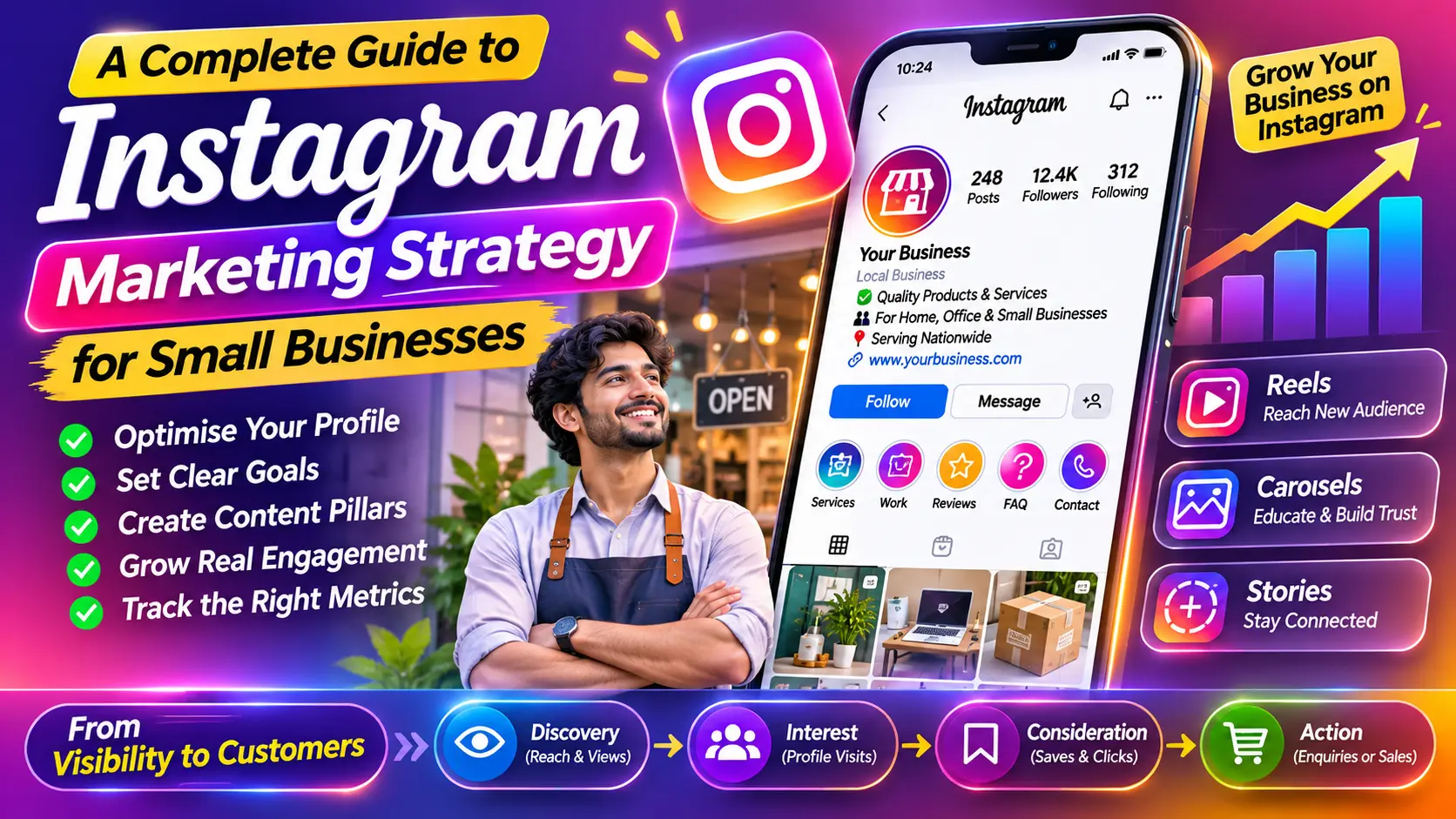
For a small business, Instagram can be more than a place to publish attractive photographs. Used thoughtfully, it can function as a discovery channel, a portfolio, a customer-service touchpoint and a source of qualified enquiries. The difference lies in having a deliberate strategy rather than posting whenever time permits.
A reliable Instagram marketing strategy does not require a large team or an extravagant advertising budget. It requires a clear audience, a recognisable proposition, content that answers real questions and a simple method for learning from performance. This guide explains how to build that foundation, what to publish and which metrics deserve your attention.
1. Why Instagram marketing matters for small businesses
People often use social platforms to discover products, compare providers, seek recommendations and assess whether a business appears credible. An active, coherent Instagram profile can help a prospective customer understand what you offer before they contact you. It can also give existing customers a convenient way to see updates, new work and answers to common questions.
However, visibility alone is not a commercial strategy. A post that receives many views may generate little business if it reaches people outside your target market or fails to explain the next step. Conversely, a modest post that reaches a relevant local audience and prompts three serious enquiries may be more valuable.
Think of Instagram as one part of a wider customer journey. Your website should provide detailed information, your contact channel should make enquiries straightforward, and your social content should help the right people discover and understand your business.
2. Set measurable goals before you create content
Begin by deciding what Instagram should contribute to the business. A single account can support several objectives, but trying to pursue all of them with equal intensity can make the content unfocused. Choose one primary objective for the next 60 to 90 days and one or two supporting objectives.
- Brand discovery: introduce your business to relevant people who have not encountered it before.
- Trust and consideration: demonstrate expertise, show completed work and address common concerns.
- Website visits: guide interested users to a useful service, product or information page.
- Enquiries and sales: encourage suitable prospects to request a quote, book a consultation or purchase.
- Customer retention: keep existing customers informed and make it easier to stay connected.
Translate the objective into a metric. For discovery, monitor reach among non-followers and profile visits. For consideration, examine saves, shares, meaningful comments and repeat profile visits. For acquisition, track link clicks, form submissions, calls or sales that can reasonably be attributed to Instagram.
This sequence is not perfectly linear. A person may see a Reel, leave the app, search your business later and then visit your website directly. Attribution is therefore imperfect. Use tracking links and ask new customers how they found you, rather than assuming every conversion will appear in one dashboard.
3. Optimise your Instagram business profile
Your profile is often the first place a potential customer goes after seeing a post. It should answer four questions quickly: who are you, what do you provide, whom do you help and what should a visitor do next?
Choose a recognisable name and profile image
Use a business name that matches your website and other public channels. A clear logo or recognisable brand mark is usually preferable to a busy graphic. Keep the image legible at a small size.
Write a useful bio
A concise bio should describe the offer in ordinary language. Include a relevant service area or audience where it helps visitors qualify themselves. Avoid filling the bio with disconnected keywords or vague claims such as “best service ever”. Specificity is more persuasive than superlatives.
Use the link destination strategically
Send visitors to a relevant landing page rather than automatically directing everyone to the homepage. A person interested in a particular service should arrive at a page that explains that service, its scope and the next action. Check the link periodically and use a tagged URL when you need to measure visits in analytics.
Organise Highlights and pinned posts
Highlights can group evergreen information such as services, process, FAQs, testimonials and contact details. Pin a small number of posts that explain your offer, demonstrate the quality of your work and answer a frequent customer question. Do not treat Highlights as an archive of every Story; curate them for new visitors.
4. Build content pillars instead of posting randomly
Content pillars are recurring subject areas that keep publishing relevant and recognisable. They make planning easier because each post has a clear purpose. For most small businesses, three to five pillars are sufficient.
| Content pillar | What to publish | Purpose |
|---|---|---|
| Educational | How-to tips, checklists, explanations and common mistakes | Demonstrate useful knowledge |
| Proof of work | Project examples, product demonstrations and process snapshots | Reduce uncertainty and build trust |
| Behind the scenes | Team introductions, preparation and day-to-day work | Make the business more relatable |
| Customer questions | FAQs, objections, comparisons and buying guidance | Help prospects make informed decisions |
| Offer and updates | New services, seasonal availability and clear calls to action | Turn interest into an enquiry |
For example, a web design studio might publish a carousel explaining mobile usability, a short Reel showing a page redesign, a Story answering a pricing question and a case study describing a client's project. A bakery might show product preparation, explain ingredient choices, share customer feedback and announce weekend availability.
The objective is not to make every post promotional. A useful balance gives the audience reasons to follow even when they are not ready to buy. When a commercial message does appear, it feels like a natural next step rather than an interruption.
Content idea carousel
Swipe or use the arrows to explore practical post concepts.
Example weekly content mix
A planning illustration—not an Instagram benchmark or guaranteed formula.
Adjust this mix to your audience, capacity and business objective. The proportions are a starting exercise, not a platform rule.
5. Use Reels, carousels and Stories for different jobs
Different formats support different communication needs. There is no universal format that guarantees reach, so select the format that communicates the idea most clearly and review how your own audience responds.
Reels: demonstrate, explain and attract attention
Short-form video can make a process visible. Show a product in use, explain one practical tip, walk through a before-and-after project or answer a frequent question. Give the video a clear opening: viewers should understand the subject immediately. Use readable on-screen text, clear audio and captions where appropriate. Avoid adding effects that obscure the information.
Carousels: teach a sequence or comparison
Carousels are useful when an idea benefits from steps, examples or a structured explanation. The first slide should state the problem or promise accurately. Each subsequent slide should contribute one point, and the final slide can summarise the lesson or invite a relevant action. Keep text concise enough to read on a phone.
Stories: maintain an ongoing conversation
Stories can communicate timely updates, answer questions and show the human side of a business. Use interactive features only when they serve a genuine purpose—for example, a poll that helps you understand customer preferences or a question prompt for collecting FAQs. Do not manufacture engagement simply to make the account appear busy.
| Format | Useful for | Example |
|---|---|---|
| Reel | Discovery and demonstration | “Three checks before launching a business website” |
| Carousel | Education and saves | “A five-step checklist for choosing a service provider” |
| Story | Updates and conversation | Answering a customer question or showing today's work |
| Live video | Longer explanation and interaction | A scheduled product demonstration or Q&A |
6. Create a content calendar you can sustain
Consistency is valuable, but consistency does not mean publishing several times every day. A schedule that exhausts the team or lowers content quality is unlikely to remain effective. Start with a cadence you can maintain for at least eight weeks, then adjust using evidence.
A small business might begin with two or three feed posts per week and Stories when there is something useful to share. One possible weekly rhythm is:
- Monday: an educational carousel addressing a common customer problem.
- Wednesday: a Reel demonstrating a product, process or practical tip.
- Friday: a project example, customer question or service explainer with a relevant call to action.
- Throughout the week: respond to genuine messages and share timely updates when appropriate.
Batching can make this routine more efficient. Set aside time to collect ideas, write outlines, record several clips and prepare captions. Keep a simple spreadsheet with the planned date, pillar, format, topic, asset status, destination link and result. Leave room for timely posts; a calendar should guide work, not prevent a useful response to a current event.
7. Build genuine engagement and community trust
Social media is a conversation channel, not merely a broadcast schedule. Respond to relevant comments and direct messages with clear, courteous answers. If a question needs a detailed explanation, move the discussion to an appropriate private channel without pressuring the person. When a customer raises a concern, acknowledge it and explain the next step instead of replying with a generic slogan.
Engagement should be relevant and reciprocal. Participate in conversations where your expertise or experience adds value. Avoid automated spam, purchased engagement and repetitive comments on unrelated accounts. These shortcuts can damage credibility and may conflict with platform rules. A smaller audience that genuinely cares about your work is often more useful than a larger audience with little connection to your offer.
Ask permission before sharing customer messages, photographs or project details. Be careful with personal information, confidential business data and claims about results. If you publish a testimonial or case study, represent the customer's experience accurately and do not imply that one outcome is guaranteed for everyone.
8. Measure performance beyond follower count
Follower count is visible, but it is not a complete measure of business impact. A better review combines distribution, content response and downstream actions. The available metrics and labels can change as Instagram updates its professional tools, so use the current in-app definitions when comparing results.
| Metric | What it helps you understand | Question to ask |
|---|---|---|
| Reach | How many unique accounts saw content | Did the post reach people beyond existing followers? |
| Watch time / retention | Whether video held attention | Did viewers leave before the main point? |
| Saves and shares | Whether content was useful or worth passing on | Was the information practical and relevant? |
| Profile activity | Whether content prompted further interest | Did viewers visit the profile or tap its links? |
| Website enquiries | Whether social activity contributed to business actions | Did relevant visitors submit a form, call or buy? |
Compare posts with similar formats and objectives. A Reel designed for broad discovery should not be judged by exactly the same criteria as a carousel intended to explain a complex service. Look for patterns across several weeks rather than making major decisions from one unusually strong or weak post.
Use tagged links where possible and review website analytics alongside Instagram insights. If the account is generating profile visits but few website clicks, the bio or call to action may need improvement. If website visits occur but enquiries do not, the landing page, offer clarity or contact process may be the bigger obstacle.
9. Common Instagram marketing mistakes to avoid
- Publishing without a defined audience: broad content can attract attention without attracting likely customers.
- Making every post an advertisement: a feed with no education, evidence or personality gives people little reason to return.
- Chasing trends without context: use a trend only when it fits your brand and helps communicate something meaningful.
- Ignoring the profile journey: strong content can lose momentum if the bio, link or pinned posts are confusing.
- Buying followers or engagement: artificial activity distorts analytics and can undermine trust.
- Using inconsistent branding: changing visual styles and unclear messaging make recognition harder.
- Failing to measure enquiries: views and likes cannot tell you the full commercial value of a campaign.
- Expecting immediate results: sustainable audience development takes testing, iteration and time.
10. A practical 30-day Instagram marketing action plan
Use the first month to establish a baseline and build a repeatable workflow. The plan below is a starting framework, not a promise of a particular growth rate.
| Period | Priority | Actions |
|---|---|---|
| Days 1–7 | Foundation | Define the audience and primary goal; improve the bio, profile image, link, Highlights and pinned posts. |
| Days 8–14 | Content system | Select three to five pillars; outline six to nine post ideas; prepare a realistic weekly calendar. |
| Days 15–21 | Publishing and conversation | Publish a mix of Reels and carousels; share useful Stories; respond to relevant comments and enquiries. |
| Days 22–30 | Review and refine | Compare reach, saves, shares, profile activity, link clicks and enquiries; identify two improvements for the next month. |
At the end of the month, write down what you learned. Which topics generated thoughtful responses? Which format was easiest to produce well? Did the profile make the next step obvious? Were enquiries relevant to the services you actually provide? These observations are more useful than simply declaring the month a success or failure based on follower growth.
11. When professional social media support can help
Managing social media alongside customer service, operations and sales can become difficult as a business grows. External support may be useful when the team needs a clearer campaign plan, consistent execution, audience targeting or a more disciplined reporting process. Before choosing a provider, clarify the scope: which platforms and assets are included, who supplies the content, what approvals are needed, how reporting works and what outcomes are realistic.
Be cautious of offers that promise a fixed number of genuine followers, guaranteed viral reach or a specific sales result. Social platforms distribute content according to many changing signals, and audience response cannot be fully controlled. A responsible campaign should explain its methods, distinguish estimates from guarantees and avoid artificial engagement.
Need help with Instagram promotion?
Explore TopRank Solution's Instagram Promotion service and review the available campaign packages, scope and estimated outcomes before choosing.
Explore Instagram promotion packages ↗Conclusion: build a strategy around people, not vanity metrics
A strong Instagram marketing strategy for a small business is built on relevance, clarity and consistency. Start with a specific audience and business objective. Make the profile easy to understand, publish content that solves real problems, use each format with intention and measure the actions that matter to the business. Then refine the plan using evidence rather than assumptions.
Instagram can contribute to discovery and customer relationships, but it works best when it is connected to a credible website, a clear service offer and a straightforward enquiry process. Keep the strategy manageable, protect customer trust and focus on steady improvements. That is a more durable foundation than chasing every new trend.
Further reading and official resources
- Instagram official blog — platform announcements and product updates.
- Instagram Help Centre — account, professional tools and feature guidance.
- Meta for Business learning resources — business and advertising education.
- Google Analytics campaign URL guidance — understand how tagged campaign links support measurement.
Editorial note: Platform features and analytics labels can change. Check Instagram's current in-app guidance before relying on a specific feature or metric. This article is educational and does not guarantee reach, followers, leads or sales.