

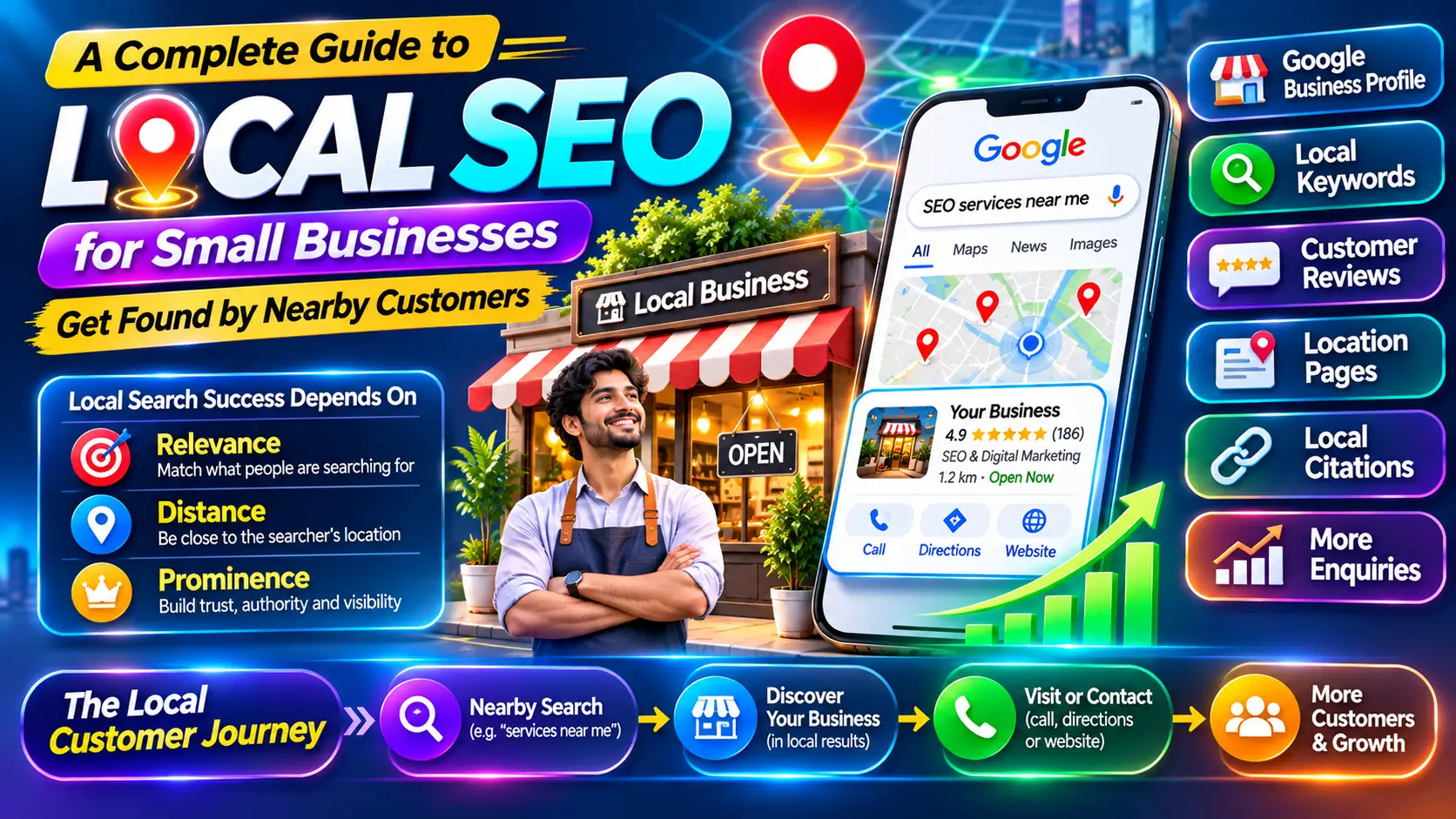
A customer who needs a nearby accountant, dentist, repair service, restaurant or marketing agency often starts with a search that includes a place, a neighbourhood or the phrase “near me”. The businesses that appear clearly and credibly in those results have an opportunity to earn attention before a customer visits their website or makes a call. Local SEO is the work of making that discovery journey accurate, useful and easy to act on.
Local visibility is not achieved by adding a city name to every page or collecting as many directory listings as possible. It depends on a consistent business identity, a genuinely helpful website, accurate location information, relevant reputation signals and a clear understanding of the areas a business can serve. This guide explains how to build those foundations without relying on shortcuts or promises of a guaranteed map position.
Start by verifying your Google Business Profile, choosing the most accurate business categories, keeping name/address/phone details consistent, creating useful pages for your actual services and locations, earning genuine customer reviews, and measuring calls, direction requests, enquiries and qualified leads. Improve the information customers rely on; do not create fake locations or keyword-stuffed listings.
1. What local SEO means and when it matters
Local SEO is the process of improving how a business appears when people search for products or services connected to a geographic area. A query may explicitly name a city, such as “accountant in Noida”, or imply location through wording such as “emergency plumber near me”. Search engines can use the query, the searcher's location and information about businesses to determine which results are relevant.
Local SEO is especially relevant when customers need a provider in a defined area, visit a physical location, request an appointment or expect a service professional to travel to them. Examples include clinics, home services, professional firms, restaurants, retail stores, education providers and agencies serving a regional market. A business that operates entirely online may still target geographic markets, but it should not pretend to have a staffed local office where none exists.
2. Understand the main local ranking considerations
Google describes local results using three broad considerations: relevance, distance and prominence. These are useful concepts for planning, but they are not a public formula that lets a business calculate an exact position. A business cannot control where every searcher is located, and no agency can honestly promise a fixed map position for every user.
How well the business profile and website match what the person is searching for.
How far the business or service location is from the searcher's location or stated area.
How established and well-known the business appears, informed by information such as links, reviews and broader references.
These considerations interact. A highly relevant business may be too far away for a search with strong local intent. A nearby business may not match the requested service. A well-known brand may have stronger prominence but still need accurate category and location information. The practical strategy is to improve the parts the business can control while serving customers honestly.
3. Build a complete and accurate Google Business Profile
For eligible businesses, Google Business Profile is a central source of information for local discovery. It can display business details, opening hours, photos, services, reviews and ways to contact the business. A profile is not a substitute for a good website, but it can help customers confirm basic details before taking the next step.
Use the real-world business name
Enter the name the business uses consistently in the real world, including on signage and customer-facing materials. Do not append extra keywords, neighbourhoods, phone numbers or promotional phrases simply to influence search. Keyword stuffing can make a listing look untrustworthy and may violate profile guidelines.
Choose the closest accurate primary category
Keep contact and operating details current
Check the address or service-area configuration, phone number, website URL, opening hours and special holiday hours. Make sure the destination page works on mobile and clearly identifies the same business. If customers must book before visiting, explain that. If the business travels to customers and does not receive them at its address, follow Google's service-area business guidance rather than displaying a private or ineligible address.
Describe services in customer language
Add the services that the business actually provides. Use clear descriptions that help a prospective customer understand the work, not a string of repeated search phrases. Where available, add relevant photos that represent the business accurately. Do not use stock imagery in a way that suggests it is a real office, team or completed project.
4. Keep business information consistent across the web
Name, address and phone number are often shortened to NAP. Consistency helps customers and platforms reconcile references to the same business. The goal is not to force every website to use identical punctuation; it is to avoid meaningful conflicts such as an old phone number, a former address or a different trading name that leaves customers unsure which listing is genuine.
Create a simple source-of-truth record containing the official business name, public phone number, website, address or service area, primary category, hours and approved description. Use it when updating the website, social profiles, directories and partner pages. Record which platforms have been updated and when.
| Business detail | What to standardise | What to avoid |
|---|---|---|
| Business name | Real-world public name | Extra ranking keywords or offers |
| Address | Correct, eligible public location | Virtual offices or invented branches |
| Phone | Current number that reaches the business | Old numbers on forgotten directories |
| Website | Canonical HTTPS URL and relevant landing page | Broken links or unrelated destinations |
| Hours | Current normal and special hours | Hours that imply availability when closed |
5. Research local keywords around services and customer needs
Local keyword research starts with the way customers describe their problem. A business may call a service by an internal industry term, while a customer searches for a simpler phrase. Build a list that combines service language, customer questions and geographic modifiers, then validate the terms with search results and available performance data.
Build a service-and-location matrix
| Customer need | Possible search wording | Useful page content |
|---|---|---|
| Find a provider | service + city | Service scope, service area and contact route |
| Compare options | best / affordable + service + area | Transparent process, suitability and limitations |
| Solve an urgent issue | emergency + service + nearby area | Real availability, response process and phone details |
| Understand cost | service cost + city | Factors affecting price and how to request a quote |
| Check credibility | business name + reviews | Accurate profile, project examples and genuine feedback |
Use Google Search Console to find queries that already generate impressions for your pages. Search suggestions and customer conversations can reveal additional language. Keyword tools can help estimate demand, but treat volume estimates as directional rather than exact counts of local customers.
Separate research from page targeting
Do not assign every keyword variation to a separate page. Group phrases that express the same intent and answer them on one strong page. If “local SEO agency Noida” and “SEO services in Noida” lead to similar results and describe the same service, one well-structured page may be more useful than two thin pages competing with each other.
6. Create useful location landing pages—not doorway pages
A location landing page should help someone in that area understand whether the business can serve them and what the service involves. It should not be a city name swapped into an otherwise identical template. Search engines and visitors both benefit when a page contains specific, verifiable information.
What a strong local landing page includes
- A clear H1 that identifies the service and location naturally.
- An explanation of the service, who it is for and what is included.
- Accurate coverage details, including any limits or appointment requirements.
- Examples, photos or project information that can genuinely be associated with the area.
- Relevant customer questions and practical answers.
- Consistent contact details and a clear next step.
- Links to related services, helpful guides and the main contact page.
7. Earn and manage genuine customer reviews
Reviews help prospective customers understand what working with a business may be like. They can describe communication, punctuality, product quality or how a team handled a problem. A review profile is most useful when it reflects real customer experiences and the business responds professionally.
Respond with care and useful detail
Thank customers for specific feedback without exposing private information. If someone raises a concern, acknowledge it and invite them to continue the discussion through an appropriate private channel. Avoid arguing, disclosing order details or copying the same generic response to every reviewer.
Four areas to review each month
8. Build local authority through relevant links and citations
Links and mentions can help people discover a business and provide context about its reputation. For local businesses, useful opportunities may include a chamber of commerce, a recognised professional association, a local event organiser, a supplier, a community organisation or a publication covering the area. Relevance and editorial value matter more than a raw count.
Practical ways to earn relevant local references
- Participate in legitimate local business associations and ensure the member profile is accurate.
- Support community events or useful initiatives where the business has a genuine role.
- Publish a practical resource that local organisations may want to reference.
- Share original project insights or expertise with relevant local publications.
- Build relationships with complementary businesses where a referral or resource link benefits customers.
- Review existing backlinks and remove or disavow links only when there is a clear reason and appropriate expertise.
9. Strengthen on-page and technical SEO for local visitors
Page titles, headings and descriptions
Internal links and navigation
Link from relevant service pages, guides and location pages using descriptive anchor text. A visitor reading a local service guide should be able to reach the relevant service details or contact page in one or two clear steps. Avoid creating large blocks of footer links that list every city regardless of relevance.
Mobile experience and page speed
Many local searches happen while people are away from a desktop. Make phone numbers tappable, keep forms short, show essential details near the top and avoid pop-ups that cover the page. Check image sizes, layout shifts and responsiveness. A fast page cannot guarantee a local ranking, but a frustrating page can make a potential customer abandon the visit.
Structured data
10. Measure local SEO with outcomes that matter
Rank tracking can show patterns, but a single position check is not a complete measure of local performance. Results can vary by searcher location, query wording, device and time. Combine search visibility with actions that indicate genuine interest.
| Measurement area | What to review | What it can tell you |
|---|---|---|
| Search Console | Queries, impressions, clicks and landing pages | How pages appear in organic search |
| Business Profile | Available profile interactions and performance data | How people discover and interact with the listing |
| Website analytics | Landing pages, calls-to-action and enquiry events | Whether visits lead to meaningful actions |
| Lead records | Qualified calls, forms, bookings and sales | Whether enquiries fit the service and area |
| Operations | Response time, missed calls and booking outcomes | Whether the business can convert demand |
11. Local SEO mistakes that waste time or create risk
- Inventing locations: do not create profiles for virtual offices, unstaffed spaces or places where the business is not eligible to operate.
- Keyword stuffing the business name: use the real-world name, not a list of services and locations.
- Publishing thin city pages: create a page only when it provides distinct value to customers in that area.
- Buying fake reviews: artificial feedback undermines trust and can violate platform policies.
- Using irrelevant directories: focus on credible sources customers might actually use.
- Ignoring the website journey: a listing may attract attention, but a confusing page or unanswered phone call can lose the enquiry.
- Chasing one map position: monitor a range of queries and business outcomes rather than treating one screenshot as definitive.
- Making changes without records: document profile and website updates so improvements or problems can be traced.
Local SEO is a long-term operating discipline. A shortcut that creates inaccurate information may produce temporary visibility but can also confuse customers and put a profile at risk. Favour changes that make the business easier to understand and contact.
12. A practical 90-day local SEO action plan
- Audit business details and profile ownership.
- Correct categories, hours, contact information and service areas.
- Review the website's key service pages and mobile experience.
- Record a baseline for search and enquiry activity.
- Research service and location queries.
- Improve the main local landing page.
- Publish genuinely useful FAQs and supporting content.
- Request honest feedback from real customers.
- Identify relevant local associations and editorial opportunities.
- Improve internal links and accurate citations.
- Review analytics, profile interactions and qualified leads.
- Prioritise the next changes based on evidence.
This plan is a starting sequence, not a promise that results will appear within 90 days. Competition, website history, business category, service area and implementation quality all influence progress. Keep a record of work completed and avoid changing several major variables at once if you want to understand what helped.
13. Check your local SEO readiness
Use this quick self-assessment to identify which part of the process needs attention first. It is a planning aid, not a Google score or a prediction of rankings.
Count these foundations: verified eligible profile, accurate business details, useful service/location page, genuine review process, and measurement of enquiries.
When all five foundations are in place, continue improving the quality of the content, customer experience and relevant local reputation. Revisit the assessment when the business adds a service, changes address, expands coverage or redesigns its website.
14. When professional local SEO support makes sense
Some businesses can manage basic profile updates and website content internally. Professional support becomes useful when several locations need coordination, the website has technical issues, existing pages compete with each other, local citations contain conflicting information or the business needs a structured link and content strategy.
Build stronger local search foundations
Explore TopRank Solution's SEO services for on-page improvements, contextual article links and authority-building work. Review the available scope and choose support that fits your website's needs.
Explore TopRank Solution servicesService scope and deliverables should be confirmed before an order begins. Search performance varies by market and website.Conclusion: make your business easier to find and trust
Effective local SEO is not a trick for placing a business on a map. It is the work of presenting accurate information, matching real customer needs, building a useful website and earning trust through genuine service. Start with the profile and business details, then improve the pages that explain what you do and where you can help.
Official tools and further reading
- Google Business Profile Help: Improve your local ranking on Google — Google's explanation of relevance, distance and prominence.
- Google Business Profile Help — profile eligibility, verification, edits and business information.
- Google Search Central: Local Business structured data — implementation guidance and requirements.
- Google Search Central: SEO Starter Guide — foundations for useful, discoverable pages.
- Google Search Console — review search queries, clicks and indexing information.
- Google Analytics: URL builders and campaign parameters — distinguish traffic sources with tagged URLs.
Article by TopRank Solution Team
SEO, website development and practical digital growth.