
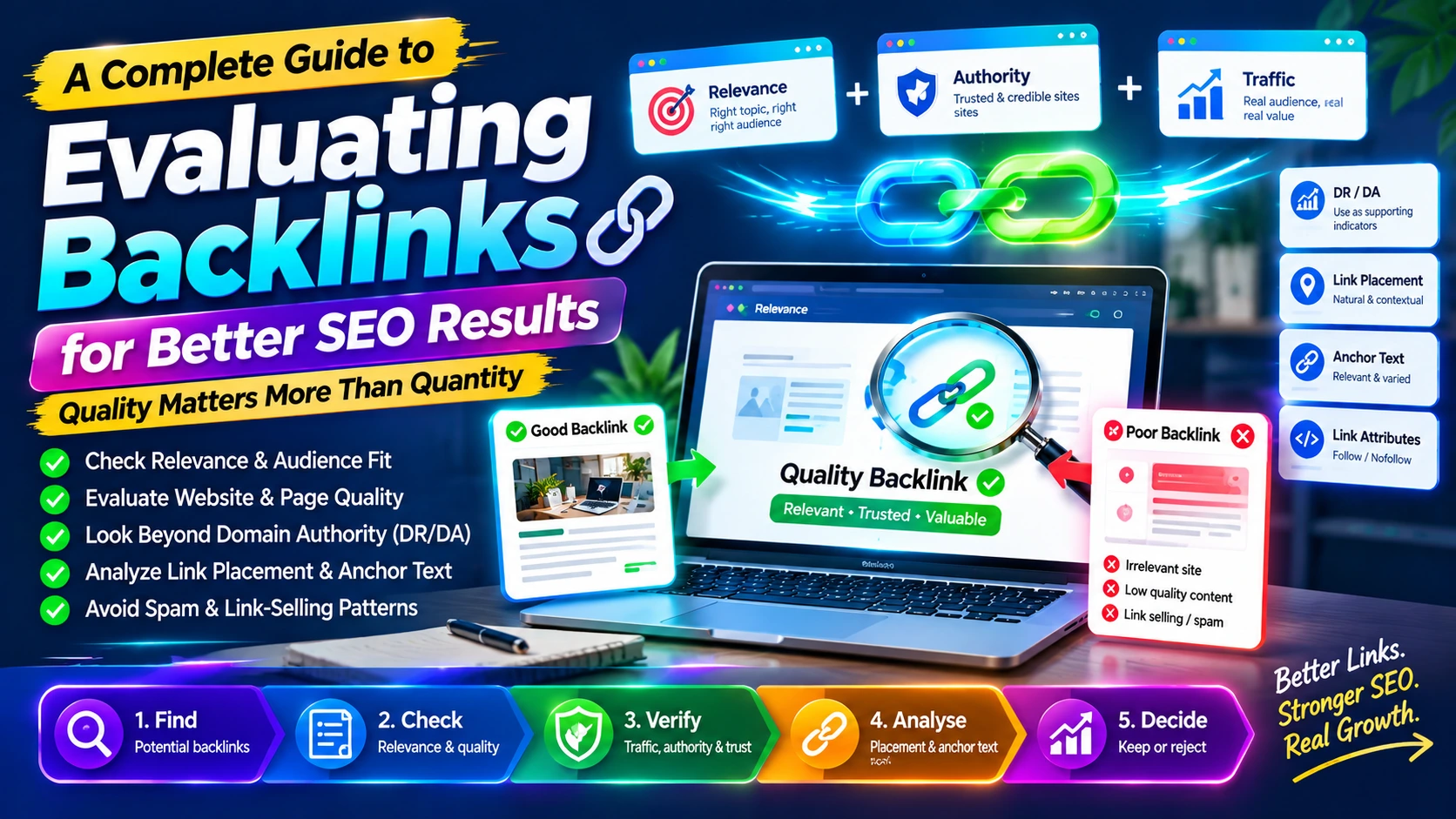
Backlinks are often discussed as if SEO were a simple numbers game: collect more links, increase a score and wait for rankings to rise. That shortcut misses the real question. Why would another website choose to reference your page, and would that reference help its readers?
A useful backlink strategy starts with that question. It considers the subject of the linking page, the reason for the reference, the quality of the destination and the wider pattern of links pointing to your website. It also recognises that no third-party metric can guarantee a search position.
1. Why backlinks still matter in a modern SEO strategy
A backlink is a link from one website to another. It can help people discover a useful resource, provide context for a claim and connect related information across the web. Search engines can also use links as part of understanding how pages relate to one another and discovering new content.
However, a link is not a guaranteed ranking boost. Its value depends on context, the linking page, the reason it exists, how it is presented and many other factors. A link from a relevant article that genuinely references your research is different from a link placed on an unrelated page simply to inflate a metric.
Think of backlinks as one part of a broader SEO system. Your page still needs to satisfy search intent, load reliably, offer useful information and be accessible to search engines. Link building cannot repair thin content, confusing navigation or serious technical problems by itself.
2. Why link quality matters more than link count
Imagine two campaigns. The first produces hundreds of links from unrelated pages with little editorial context. The second earns a smaller number of references from websites that cover the same subject and whose readers may genuinely benefit from the destination. The second campaign may offer a more coherent profile even though its raw link count is lower.
When evaluating a potential link, consider topical fit, editorial purpose, real audience, page quality, placement and transparency. A high third-party authority score alone does not prove that a page is relevant, editorially sound or valuable to your audience.
Domain Authority, Domain Rating and Trust Flow can help compare sites within their respective tools, but they are third-party metrics—not Google scores or guarantees.
3. Topical relevance: the context behind a useful link
Relevance is not limited to matching a keyword. It means the linking page and destination make sense together. A marketing article linking to a detailed guide about measuring campaign performance has a clear relationship. A random entertainment page linking to an unrelated accounting service may not.
Evaluate relevance at two levels. First, consider the website's main subject and audience. Second, inspect the exact page where the link would appear. A broad publication may cover many topics, but the individual article still needs a sensible reason to cite your page.
If any part of the connection feels forced, reconsider the opportunity. A relevant link should make sense to a person reading the page, even if they know nothing about SEO.
4. Understand the main types of backlinks
Editorial mentions occur when an author references a resource because it supports the article. Guest articles involve contributing original content to a publication. Niche edits add a link to an existing relevant article. Business citations reference a business and its details, while resource links appear in curated collections of tools or further reading.
These opportunities serve different purposes. Review editorial standards, audience fit, disclosure requirements and the usefulness of the placement rather than treating every link type as interchangeable.
Links may use attributes such as rel sponsored or rel ugc to identify paid placements or user-generated content. Follow publisher rules and current search engine guidance. A legitimate link can have referral and audience value even when it is qualified.
| Link opportunity | How it works | What to review |
|---|---|---|
| Editorial mention | An author references your resource because it supports the article. | Context, source credibility and genuine usefulness. |
| Guest article | You contribute original content to a publication. | Editorial standards, audience fit, disclosure and link attributes. |
| Niche edit | A relevant link is added to an existing article. | Whether the existing page is maintained and the addition improves it. |
| Business citation | A business listing references your website and details. | Accuracy, legitimacy and relevance to the business. |
| Resource link | A page lists useful tools, references or further reading. | Whether your resource genuinely belongs in that collection. |
5. Audit your existing backlink profile before building more
Before ordering a new campaign, understand what already points to your website. A backlink audit helps identify useful references, irrelevant patterns, lost links and pages that attract attention. It also prevents spending money to repeat work that has already been done.
Export available backlink data from tools you use, such as Google Search Console and commercial SEO platforms. Different tools crawl different parts of the web, so their totals will not match exactly. Treat the exports as useful samples rather than a complete record of every link on the internet.
Identify pages receiving external links, group referring domains by topic, check whether important links still resolve, review anchor text patterns and investigate unusual bursts or repeated placements. Do not disavow links simply because a tool labels them toxic or because their authority score is low. Diagnose carefully and consult Google's current guidance before taking action.
6. Build a backlink plan around useful pages
Not every URL on your website deserves the same link-building effort. Choose pages that have a clear purpose and are worth recommending. These might include original research, detailed guides, useful tools, strong service pages or well-organised resources that answer a recurring customer question.
For each target page, record the audience, search intent, unique value, current internal links and the types of websites that might reasonably reference it. If the page is a commercial service page, a supporting educational guide may be a more natural outreach destination. Readers can then discover the service through a relevant internal link.
Prepare the destination before outreach. Make sure it is accurate, easy to navigate, mobile-friendly and clear about what it offers.
7. Create assets that people have a reason to cite
Outreach becomes easier when the destination offers something distinctive. A generic sales page gives an editor fewer reasons to reference it than a well-researched guide, a practical calculator or a transparent explanation of a difficult process.
Useful linkable assets do not need to be complicated. Consider a step-by-step guide, an original comparison table with transparent criteria, a downloadable checklist, a calculator or template, a small research project with a clear method, or an expert explanation that answers common questions without exaggeration.
Keep these resources updated. If a statistic changes, a tool breaks or a recommendation becomes outdated, correct it. A linkable asset should remain useful after the outreach email has been sent.
8. Make outreach relevant, specific and respectful
Good outreach is not a mass email with a generic compliment and a demand for a backlink. It is a short explanation of why you are contacting a particular editor or website owner and how the proposed resource could help their audience.
Before contacting someone, read the page, understand its editorial focus and check whether it accepts contributions or resource suggestions. Personalise the message with a real observation. Explain what your resource adds, disclose any commercial relationship and make it easy for the recipient to decline.
Avoid automated campaigns that send the same message to hundreds of unrelated websites. A smaller, researched list is easier to manage and less likely to damage your brand reputation.
9. Use natural anchor text and sensible destination pages
Anchor text is the visible, clickable wording of a link. It gives readers and search engines context about the destination. It should describe the linked page naturally and fit the sentence around it.
Do not force an exact-match keyword into every placement. A natural backlink profile can include brand names, page titles, descriptive phrases, URLs and ordinary language. The right wording depends on the publisher's editorial style and the reason for the reference.
Also check the destination. A link should lead to the most useful page, not automatically to the homepage. Avoid redirect chains, broken URLs and pages that do not fulfil the promise made by the anchor text.
10. Measure progress without chasing vanity metrics
Backlink reports often highlight total links, referring domains, Domain Rating, Domain Authority or Trust Flow. These figures can help track changes within a particular tool, but none should be treated as a direct measurement of Google rankings or business growth.
Track whether the target page is indexed, whether relevant referral visits arrive, whether visitors engage and whether the page's organic performance changes over time. Compare against a baseline and account for other SEO work, seasonality and search demand.
Avoid claiming that one new link caused a ranking change without evidence. Use metrics as diagnostic signals, not promises.
11. Backlink mistakes that can waste budget or create risk
Common mistakes include buying by score alone, ordering large quantities without reviewing placements, ignoring paid-link disclosures, repeating exact-match anchors, pointing every link to the homepage, skipping an audit and expecting instant rankings.
Google's spam policies describe link schemes that attempt to manipulate search rankings. Review the current guidance before running a campaign, especially when money, reciprocal arrangements, automated placement or large-scale guest posting are involved.
A provider should explain its process clearly rather than promise guaranteed positions. Ask how websites are selected, whether you can review them and how paid relationships are handled.
12. A practical 90-day backlink improvement roadmap
Days 1–15: export link data, review target pages, check technical health and set a baseline. Days 16–30: update key guides, add useful evidence, strengthen internal links and prepare a researched list of relevant outreach targets.
Days 31–60: contact relevant publishers, explore suitable guest contributions and evaluate existing-page opportunities. Days 61–90: verify placements, review referral activity, check target-page performance and plan the next cycle.
Use the roadmap as a starting point, not a promise that a certain number of links or ranking gains will appear within 90 days. The right pace depends on the niche, content quality, publisher response times and available resources.
| Period | Priority | Practical actions |
|---|---|---|
| Days 1–15 | Audit and preparation | Export link data, review target pages, check technical health and set a baseline. |
| Days 16–30 | Improve linkable assets | Update key guides, add useful evidence, strengthen internal links and prepare outreach targets. |
| Days 31–60 | Selective outreach | Contact relevant publishers and assess suitable guest contributions or existing-page opportunities. |
| Days 61–90 | Review and refine | Verify placements, review referral activity, check target-page performance and plan the next cycle. |
13. When professional link-building support makes sense
Professional support can be useful when your team lacks time to research publishers, review backlink opportunities, prepare content and maintain campaign records. The important part is knowing what work is actually included.
Ask a provider how it selects websites, checks page relevance, handles sponsored placements, chooses destination URLs, manages anchor text and reports completed work. Request clarity about whether content is included, whether you can approve target sites, how lost links are handled and what the provider will not do.
TopRank Solution offers backlink-related options including manual blog backlink building, guest posting and niche edits. Review the scope and suitability for your niche before placing an order; no service can guarantee a particular Google ranking or a specific change in a third-party authority metric.
Looking for a backlink-building plan?
Explore TopRank Solution's backlink services, including manual blog backlinks, guest posting and niche edits. Share your website niche and target pages so the requirements can be discussed before a campaign begins.
Explore backlink services ↗Conclusion: build links that make sense to people
A strong backlink strategy is not a race to collect the largest number of links or the highest third-party score. It is a disciplined process: understand your current profile, choose pages worth recommending, identify relevant publishers, create useful resources and measure what happens after a placement.
Keep the reader's experience at the centre of each decision. If a link is relevant, transparent and genuinely useful, it has a clearer purpose than a placement created only to manipulate a metric. Combine that approach with technically sound pages, helpful content and consistent measurement to build a more sustainable SEO programme.
Useful official resources
- Google Search spam policies — understand link spam and other practices that violate search policies.
- Google guidance on crawlable links — learn how to make links accessible to crawlers.
- Links report in Search Console — review the links data available for your property.
- Google Search Essentials — review the core technical and spam-policy guidance.
Editorial note: This article is general educational information, not a promise of rankings or a substitute for a site-specific SEO audit. Search policies and tool features can change; consult current official documentation when planning a campaign.