Search and digital marketing are moving beyond isolated tasks. AI agents can research and coordinate workflows, search experiences are becoming more conversational, and advertising platforms are adding more automation. At the same time, businesses still need something durable: useful pages, a credible reputation, relevant links and a clear path from discovery to customer action.
This creates a new opportunity for businesses that sell SEO, backlinks, domain-metric campaigns and paid promotion. Instead of treating every service as a separate score or traffic package, connect them into one operating system: build topical depth, earn references, strengthen discoverability, use AI agents to improve execution and measure the business impact.
Metric reality check: Moz DA and Ahrefs DR are third-party metrics. They are useful for comparative analysis, but neither is a Google ranking score or a guaranteed business outcome.
1. Stop treating domain authority as the whole SEO strategy
Domain Authority (DA) and Domain Rating (DR) are useful third-party indicators, but they are not interchangeable and neither is a Google ranking score. Moz calculates DA using its own link and ranking model; Ahrefs calculates DR from its own backlink data and methodology. Their numbers can help compare sites within the same tool, but they do not reveal the complete quality, relevance or commercial value of a website.
The 2026 opportunity is to build a system in which authority is earned through useful expertise, strong pages, relevant references, brand recognition and measurable audience demand. A dashboard score can be one diagnostic input. It should not become the campaign objective by itself.
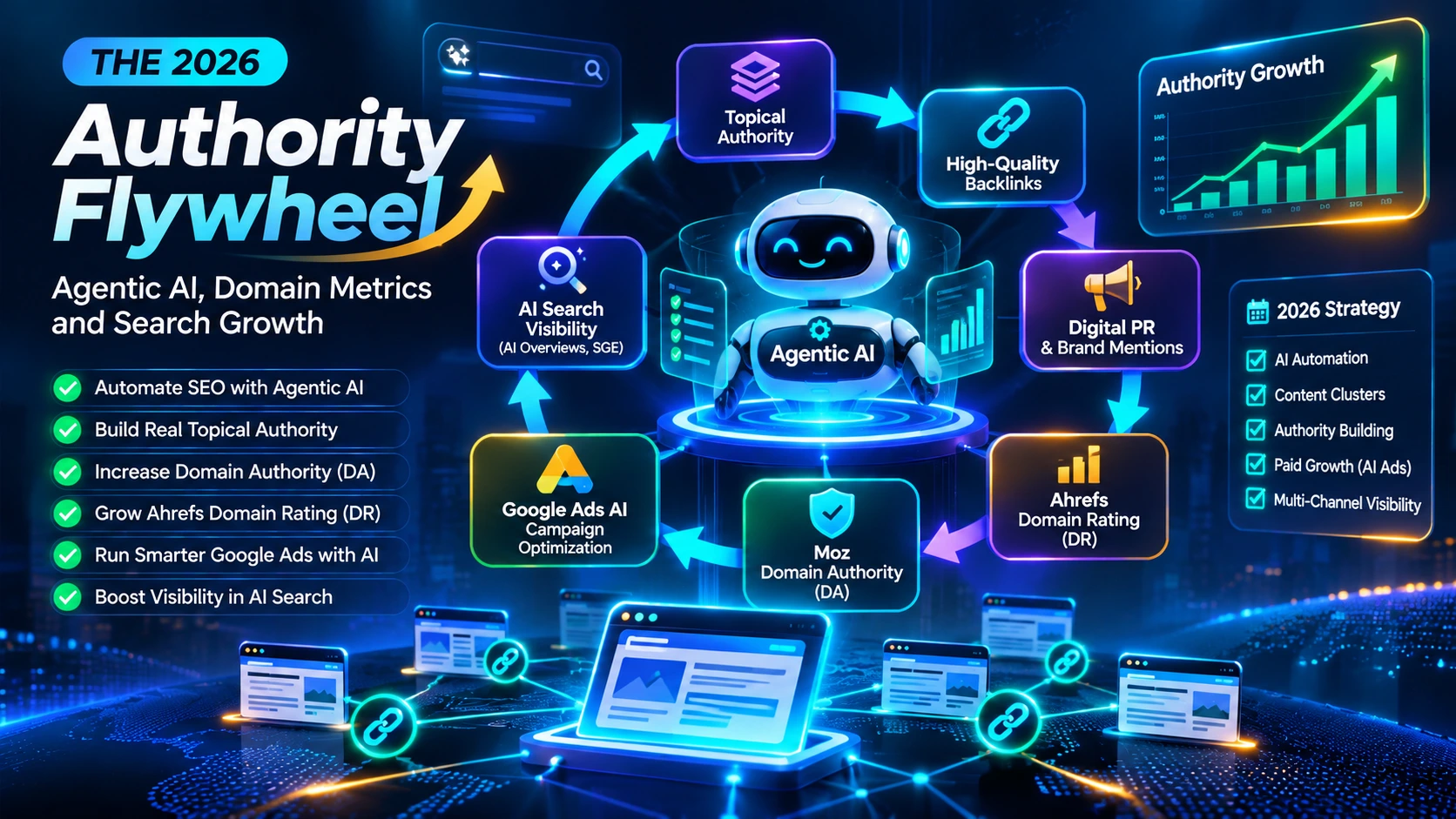
Think of authority as a flywheel rather than a number: publish something worth citing, make it easy to discover, earn relevant references, strengthen the destination with internal links, learn from performance and create the next useful asset.
2. The 2026 authority flywheel: six connected growth loops
A sustainable programme links six activities. First, research a specific audience problem. Second, create a genuinely useful asset that addresses it. Third, distribute that asset through relevant editorial, partner and owned channels. Fourth, earn citations and brand mentions where the resource adds value. Fifth, connect related pages with a clear internal-link structure. Sixth, measure outcomes and use the findings to improve the next asset.
These activities reinforce one another. A strong guide can support a service page; a digital PR mention can introduce the guide to a new audience; internal links can help visitors discover related resources; and analytics can reveal which questions deserve deeper coverage.
The flywheel does not guarantee a DR or DA increase. It creates a repeatable operating model that can improve the quality and coherence of your website's organic growth.
3. Where agentic AI fits into modern SEO operations
Generative AI can draft text or summarise information. Agentic AI goes further: an agent can plan a multi-step task, use approved tools, inspect results, take defined actions and report what happened. In an SEO workflow, that might mean checking a list of URLs, identifying pages with missing metadata, grouping Search Console queries by intent, drafting a content brief and preparing a review queue.
The useful model is not an autonomous bot with unrestricted access to a website. It is a controlled workflow with clear permissions, approved data sources, human review and an audit trail. Agents should prepare recommendations and low-risk changes; a responsible person should approve publishing, link placements, budget changes and other consequential actions.
Start with bounded tasks. For example, a research agent can collect competitor page themes; an analysis agent can group query data; a content agent can prepare outlines; and a QA agent can check links, headings, metadata and schema before a human editor signs off.
4. Design a human-supervised agentic SEO workflow
An effective workflow has a defined input, a limited set of tools, an expected output and a review gate. A research agent might receive a list of approved competitors and return topic gaps with source URLs. A technical agent might crawl a staging site and return broken links, redirect chains and indexability observations. A reporting agent might summarise weekly changes without changing live settings.
Use separate roles instead of one all-powerful agent. Keep credentials in secure systems, grant read-only access where possible, limit write permissions, log every action and require confirmation before an agent edits production pages, sends outreach or changes advertising settings.
Build a test set before deployment. Compare the agent's recommendations against a human-reviewed sample, measure false positives and omissions, and define conditions that require escalation. If the agent cannot verify a fact or source, it should label the gap rather than invent an answer.
| Agent role | Safe starting task | Human approval gate |
|---|---|---|
| Research agent | Group queries and collect source URLs | Verify evidence and topic priority |
| Technical agent | Flag broken links and metadata gaps | Approve production changes |
| Content agent | Draft briefs and internal-link suggestions | Fact-check and edit before publishing |
| Reporting agent | Summarise approved analytics exports | Interpret results and decide actions |
5. Build topical authority with evidence, not repetitive articles
Topical authority is best approached as a useful coverage system, not a target word count. Identify the real questions customers ask before, during and after buying. Group them into topic clusters, then create a strong central guide supported by focused pages that answer specific sub-questions.
Each page should contribute something distinct: original examples, clear explanations, first-hand process details, transparent comparisons, diagrams, data or practical tools. Avoid publishing near-duplicate articles simply to occupy more URLs. A large volume of interchangeable AI-generated pages can dilute quality rather than establish expertise.
An agent can help map search queries to existing pages, identify overlap and propose missing coverage. A subject-matter reviewer must verify claims, add real experience and decide whether a new page is genuinely necessary.
6. Digital PR and brand mentions: earn references people trust
Digital PR is the practice of earning attention and references through stories, useful research, expert commentary, original data and relevant collaborations. It can create awareness and referral traffic while giving journalists, publishers and industry communities a reason to mention a brand.
Create a citation-worthy asset before outreach. Examples include a transparent industry survey, a useful benchmark with a published methodology, a calculator, a detailed case study with permission, or an expert explanation of a timely issue. Make the evidence easy to verify and explain the limitations.
Do not confuse a brand mention with a guaranteed backlink or ranking benefit. A mention may help people discover a business even when it is not linked. Never fabricate research, buy undisclosed editorial endorsements or mass-email unrelated websites.
7. Grow Ahrefs Domain Rating through a healthier link ecosystem
Ahrefs Domain Rating is a proprietary metric designed to reflect the strength of a website's backlink profile in Ahrefs' index. It is influenced by the quantity and quality of followed links from unique domains and how those linking domains distribute their link equity. It is not a Google metric, and changes in the index or the wider link graph can affect the reported score.
A practical DR improvement plan begins with relevant referring domains, not a bulk link target. Review which pages attract natural links, find credible publications and partners in the same subject area, create assets worth citing and make sure important pages are easy to reach from the site structure.
Use Ahrefs to monitor referring-domain trends, lost and gained links, anchor patterns and target-page distribution. Investigate sudden changes instead of assuming every increase is beneficial. A higher DR does not prove that traffic, conversions or rankings improved.
Do not optimize the number in isolation. Compare like with like inside the same tool, review the underlying referring pages and connect the work to relevant traffic, enquiries or sales.
8. Improve the signals that Moz Domain Authority is designed to estimate
Moz Domain Authority is a predictive metric built by Moz to estimate a site's ranking potential relative to other sites. It is not a Google ranking factor. Its value is most useful for comparative research when you use it consistently within the same tool and understand that it can fluctuate as the link graph and model change.
To support a stronger link profile, improve the pages that deserve references, strengthen relevant internal pathways and earn editorial links from real websites with an audience related to your subject. Review the quality of linking pages and domains rather than selecting prospects by DA alone.
DA and DR may move differently because their providers use separate indexes, calculations and update schedules. Do not promise a customer a precise score increase as if it were fully controllable. Report the work completed, the referring sources, the target pages and the observed outcomes.
Do not optimize the number in isolation. Compare like with like inside the same tool, review the underlying referring pages and connect the work to relevant traffic, enquiries or sales.
9. Prepare content for AI-assisted search without chasing hacks
Search experiences increasingly include generative summaries and conversational interfaces. This changes how people discover information, but it does not make foundational website quality irrelevant. Clear page structure, crawlable links, helpful content, accurate information, original evidence and a good page experience remain sensible priorities.
Create pages that answer real questions directly and then provide enough depth for readers who need more. Use descriptive headings, meaningful examples, accurate author and business information, relevant images and clear source references. Make key facts visible in the page rather than hiding essential context in decorative widgets.
Avoid claims that a special file, magic prompt, keyword density or artificial content chunking guarantees inclusion in AI answers. Google has published guidance for website owners navigating generative AI features; follow current documentation and treat visibility as something to monitor, not something a provider can guarantee.
10. Connect Google Ads AI automation to real business outcomes
AI-powered advertising features can help expand query matching, generate creative variations, adjust bids and identify opportunities. In 2026, Google's AI Max for Search and other AI-enabled campaign capabilities make campaign inputs, measurement quality and advertiser controls especially important. Automation can find patterns at scale, but it still needs accurate conversion signals and clear business constraints.
Before enabling broader automation, define valuable conversions, check tagging and consent configuration, review landing-page quality and prepare a useful range of creative assets. Set budgets and geographic or brand constraints deliberately. Monitor search-term insights, channel reporting, lead quality and actual revenue where possible.
Do not judge campaign success by impressions or cheap clicks alone. For lead generation, connect leads to qualified opportunities and closed business when lawful and technically possible. For ecommerce, validate purchase values, refunds and duplicate events. Keep human approval over major budget changes and campaign restructures.
11. Build one measurement model across SEO, authority and paid growth
SEO, backlinks, AI discovery and paid campaigns often sit in separate reports. A shared measurement model helps connect activity to business outcomes without pretending that every metric measures the same thing.
Track four layers. Activity: content published, outreach completed and technical fixes deployed. Visibility: organic impressions, relevant queries, referral visits and paid reach. Engagement: engaged sessions, meaningful page interactions and returning visitors. Outcomes: qualified enquiries, sales, pipeline value or another business objective.
Keep third-party DA and DR in a separate diagnostic panel. Do not combine them into a fabricated authority score or use them as a substitute for traffic and revenue. Annotate major site changes and campaign launches so the team can interpret movement in context.
| Measurement layer | Examples | What it tells you |
|---|---|---|
| Activity | Assets, outreach, technical fixes | What the team actually completed |
| Visibility | Search impressions, referrals, paid reach | Where discovery is happening |
| Engagement | Useful visits, return users, interactions | Whether attention is relevant |
| Outcomes | Qualified leads, sales, pipeline | Whether marketing supports the business |
| Diagnostics | DA, DR, referring domains | How third-party link metrics are moving |
12. A 90-day authority and agentic growth operating plan
Days 1–15: establish a baseline. Audit important landing pages, backlink sources, current topic coverage, technical health, conversion tracking and existing Google Ads measurement. Choose a small set of priority topics and business outcomes.
Days 16–30: build the workflow. Prepare one or two linkable assets, define agent roles and permissions, create human review gates and establish a dashboard that separates activity, visibility, engagement and outcomes.
Days 31–60: distribute and test. Run focused digital PR outreach, improve internal links, publish genuinely useful supporting pages and test bounded agentic workflows. If using Google Ads AI features, start with clear conversion definitions and controlled budgets.
Days 61–90: evaluate quality. Review the relevance of earned links, changes in referring domains, DA and DR trends, organic and AI-assisted discovery where measurable, lead quality and paid campaign performance. Retire low-value activities and scale only the workflows that demonstrate useful results.
13. What to ask before buying an authority or AI marketing service
Ask a provider to explain the actual work, not just the promised score. For backlink services, request the selection criteria, sample placement types, target-page process, anchor-text approach, disclosure policy and reporting format. Ask whether you can review placements and how irrelevant or removed links are handled.
For DA or DR campaigns, ask which work is performed and which metrics are monitored. A service cannot directly control Moz or Ahrefs' proprietary calculations, and no legitimate provider should guarantee Google rankings from a metric change.
For agentic AI or Google Ads management, ask what systems are connected, which permissions are granted, what actions require approval, how data is protected and how campaign outcomes are measured. Confirm who remains accountable for the final decisions.
TopRank Solution provides backlink-related services, Ahrefs Domain Rating and Moz Domain Authority campaigns, and Google Ads/social promotion options listed on its services page. Review the live package descriptions and confirm the exact deliverables before ordering.
Build a connected authority and growth strategy
Explore TopRank Solution's backlink building, Ahrefs Domain Rating, Moz Domain Authority and Google Ads/social promotion services. Review the live package scope and discuss your website goals before selecting a campaign.
Explore TopRank Solution services ↗Conclusion: build a system, not a vanity score
The strongest 2026 strategy is not to chase a single DA or DR target, publish endless AI-written articles or hand an advertising account to an uncontrolled agent. It is to connect useful expertise, credible references, clean technical foundations, measured campaigns and human-supervised automation.
Use agentic AI to reduce repetitive research and reporting. Use Moz and Ahrefs metrics as diagnostic tools. Use digital PR and useful assets to earn attention. Use Google Ads automation with accurate conversion data and clear guardrails. Then judge the programme by the quality of discovery, audience engagement and business outcomes it creates.
2026 resources and platform guidance
- Google: New opportunities, control and insights for website owners (June 2026; updated August 2026) — generative AI Search features and website-owner controls.
- Google: New AI tools from Google Ads and Analytics (August 2026) — agentic experiences and marketing workflows.
- Google Ads AI Essentials 2.0 (January 2026) — data, content, performance and agentic capabilities.
- Google: Dynamic Search Ads upgrading to AI Max (2026) — campaign transition information and advertiser controls.
- Google Search Central: AI features and your website — current guidance for website owners.
- Moz: Domain Authority — explanation of Moz's third-party metric.
- Ahrefs: Website Authority Checker — explanation and use of Ahrefs DR.
Editorial note: This article discusses strategy and platform capabilities, not guaranteed search visibility, DA/DR increases, advertising performance or revenue. Features and availability can change; check the linked official documentation and the live service scope before making decisions.