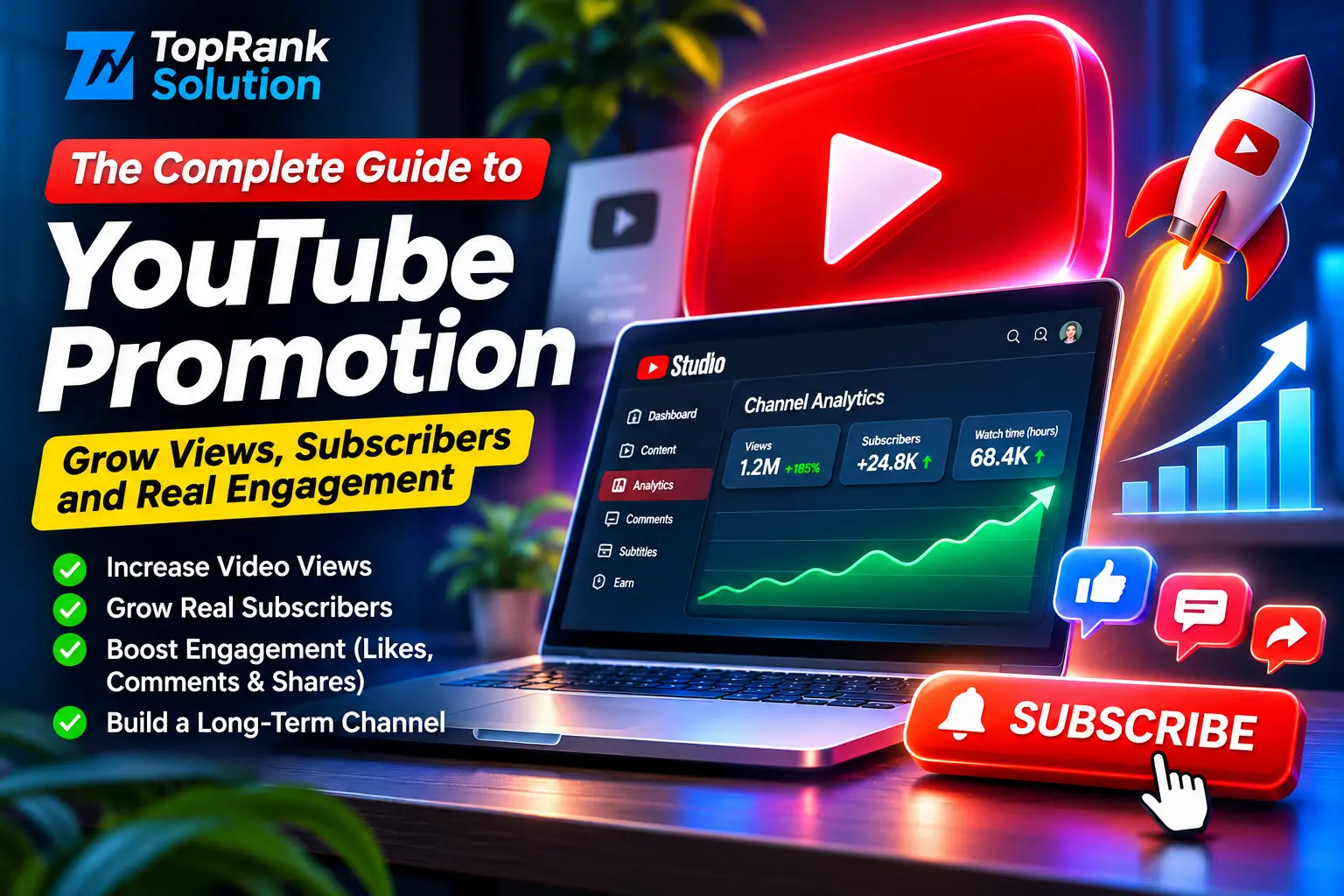
Publishing a video is only one part of growing a YouTube channel. Even useful videos can struggle to find an audience when the topic is unclear, the title does not match what viewers search for, the thumbnail is difficult to understand or distribution stops immediately after upload.
A strong promotion strategy gives each video a better chance of reaching people who are likely to care about it. It combines content quality, audience research, packaging, relevant distribution and analytics. It also avoids shortcuts that inflate numbers without building a real audience.
1. What YouTube promotion really means
YouTube promotion is the work of helping the right audience discover videos and giving viewers a clear reason to watch more. It includes the content itself, packaging such as titles and thumbnails, distribution through relevant channels, community engagement and ongoing performance analysis.
Promotion is not simply generating a large view count. A video can attract many accidental clicks yet fail to hold attention or bring viewers back. A more useful campaign reaches people who are genuinely interested in the topic and gives them a satisfying viewing experience.
Sustainable growth therefore combines discoverability with viewer satisfaction. The aim is not to manufacture activity, but to make valuable videos easier to find and easier to understand.
2. Set a clear goal before promoting a video
Start by deciding what the campaign should achieve. Different goals require different creative choices and measurement. A tutorial may aim to earn search traffic over time, a product demonstration may aim to generate qualified website visits, and a creator series may aim to build returning viewers.
Choose one primary goal and a small set of supporting measures. For awareness, monitor relevant reach and unique viewers. For deeper viewing, examine watch time and average view duration. For community growth, review returning viewers, subscribers gained and meaningful comments. For a business channel, track qualified visits or enquiries where measurement is available.
Avoid choosing a target solely because it looks impressive. A subscriber target is useful only when the channel is attracting people likely to watch future uploads.
| Campaign goal | Useful indicators | What to learn |
|---|---|---|
| Awareness | Reach, impressions, unique viewers | Is the content being shown to the intended audience? |
| Deeper viewing | Watch time, average view duration, retention | Does the video deliver on its promise? |
| Community growth | Returning viewers, subscribers gained, comments | Are viewers interested in future uploads? |
| Business outcomes | Qualified visits, enquiries, conversions | Does the audience take a relevant next step? |
3. Understand the audience you want to reach
Before selecting promotion channels, describe the viewer you want to attract. Consider their interests, skill level, questions, location, language and the type of content they already watch. The more specific the audience, the easier it becomes to choose a useful topic and distribution context.
Use YouTube Analytics, comments, search suggestions and conversations with customers to identify recurring questions. Look for patterns: beginner questions, comparisons, troubleshooting needs, product research or entertainment preferences. Turn those patterns into video ideas that deliver a clear answer.
Do not target unrelated audiences simply because a placement promises a large number of impressions. A smaller group with a strong interest in the subject can be more valuable than broad exposure with little intent.
4. Build videos that deserve promotion
Promotion can create an opportunity to be seen, but the video must deliver on the promise made by its title and thumbnail. Start with a clear opening that tells viewers what they will learn or experience. Remove long introductions that delay the main value, organise the content into understandable sections and finish with a relevant next step.
For educational videos, demonstrate the process rather than only describing it. For reviews, explain the criteria and limitations. For entertainment, establish the premise quickly and maintain a coherent pace. For business videos, show the problem, solution and evidence without turning every minute into a sales pitch.
Before investing in distribution, review the video on a phone, check audio clarity, confirm captions where appropriate and make sure the opening matches the title and thumbnail.
5. Improve titles and thumbnails for discovery
A title and thumbnail work together as a promise. The title explains the topic, while the thumbnail helps a viewer understand the idea quickly. Both should be accurate, distinctive and readable on a small screen.
Put the main subject or benefit near the beginning of the title. Use the words viewers naturally use when searching, but avoid awkward keyword repetition. A thumbnail should have one dominant visual idea, clear contrast and limited text. Do not use imagery or claims that the video does not support.
Test improvements using YouTube's available testing features when eligible, or compare performance across similar uploads while accounting for differences in topic and audience. Do not assume a higher click-through rate always means a better video; viewers still need to be satisfied after clicking.
6. Use Shorts as a discovery path, not a shortcut
YouTube Shorts can introduce a channel to viewers who may not yet know it. A strong Short communicates one idea quickly, uses an opening that earns attention and provides a satisfying ending. It should be understandable on its own rather than feeling like an incomplete advertisement for a longer video.
Create Shorts that are connected to the channel's main subject. A cooking channel might share one technique; a technology channel might explain one feature; a gaming channel might show one memorable moment. When a related long-form video exists, use the available related-video feature where appropriate so interested viewers can continue watching.
Do not assume every Shorts viewer will become a long-form viewer. Compare the audiences and outcomes separately, then use the formats for the roles they perform best.
7. Optimise videos for YouTube search and suggested discovery
Search optimisation begins with understanding the question behind a query. Review how people phrase the topic, then create a video that answers it clearly. Include the main subject naturally in the title and description, and add chapters when they help viewers navigate longer content.
Write a useful description that explains what the video covers and includes relevant links or disclosures. Add accurate captions, select an appropriate category and use tags mainly for common misspellings or context where they are useful. Tags are not a substitute for a compelling video or clear metadata.
Suggested and browse discovery depend on many signals and viewer behaviour. There is no reliable formula that guarantees a recommendation. Publish consistently enough to learn from results, but do not sacrifice quality just to meet an arbitrary upload frequency.
8. Promote videos beyond YouTube in relevant places
External promotion works best when the video genuinely adds value to the place where it is shared. Embed a tutorial in a relevant help article, share a short highlight with an interested social community, include a video in a customer email when it answers a real question, or link to it from a related resource on your website.
Adapt the message to each platform. A short social caption should explain why the video is relevant; a newsletter should connect it to the reader's interest; a community post should follow that community's rules. Avoid repetitive posting, unsolicited direct messages and dropping links into unrelated discussions.
Make sure external distribution does not mislead viewers about the video or its creator. Where a placement is sponsored or paid, use appropriate disclosures and platform tools.
9. When paid YouTube advertising makes sense
YouTube advertising can be useful when you have a defined audience, a clear campaign objective and a video suited to paid distribution. It can help test creative concepts, introduce a product or reach a chosen audience segment. Paid exposure, however, should be evaluated separately from organic channel growth.
Before running ads, define the action you want viewers to take and set a realistic budget. Choose targeting that matches the offer, prepare a landing page if the campaign is intended to generate leads, and monitor cost and conversion quality rather than views alone.
Advertising views and subscribers are not interchangeable with organic audience development. Review current Google Ads and YouTube policies, understand how paid activity is reported and never describe ad delivery as guaranteed organic recommendation.
10. Read analytics to understand what to improve
Analytics are most useful when they help answer a decision. If viewers leave early, inspect the opening and whether it matches the title's promise. If impressions are available but clicks are weak, review the title and thumbnail. If clicks are strong but average viewing is low, examine pacing, clarity and audience fit.
Review traffic sources to understand whether viewers arrive through search, browse features, suggested videos, Shorts feed, external links or paid activity. Compare videos with similar formats and topics rather than treating every upload as directly comparable.
Track subscribers gained alongside returning viewers and watch behaviour. A campaign that attracts a large but disconnected audience may not strengthen the channel. Look for evidence that viewers return for more content.
11. Encourage genuine engagement and returning viewers
Engagement grows from a positive viewing experience and a clear invitation to participate. Ask a specific question related to the video, respond constructively to useful comments and use community posts to learn what viewers want next. A pinned comment can add context or direct viewers to a related resource.
Build repeatable formats so viewers know what to expect. Consistent topics, recognisable presentation and a realistic publishing rhythm can help a channel become familiar. Consistency does not mean uploading every day; it means maintaining a standard viewers can rely on.
Never buy fake views, automated likes, bot comments or artificial subscribers. These tactics distort analytics, can violate platform policies and do not create an interested audience. Avoid services that promise guaranteed viral results or undisclosed engagement.
12. YouTube promotion mistakes to avoid
Common mistakes include promoting every video to an unrelated audience, using misleading thumbnails, changing topics constantly, buying artificial engagement, ignoring retention, overloading descriptions with keywords and judging success from one metric.
Another mistake is sending viewers to a channel with no clear next step. Organise playlists, feature a useful introduction video and make the channel description explain who the content is for. A visitor should be able to understand the channel's value quickly.
Finally, do not promise a specific number of views, subscribers or revenue unless the outcome is genuinely under your control—which it usually is not. Platform distribution changes and results vary by topic, creative quality, audience and budget.
13. A practical 30-day YouTube promotion plan
Week 1 — Audit the channel. Review the audience, best-performing topics, traffic sources, retention patterns and channel presentation. Choose one primary goal and identify two or three videos that deserve additional attention.
Week 2 — Improve packaging and viewer journey. Refresh unclear titles or thumbnails where justified, improve descriptions, add relevant end screens and organise playlists. Prepare a short-form clip or companion post that introduces the video's core value.
Week 3 — Distribute selectively. Share the video in relevant communities and owned channels where it answers a real question. If using paid ads, define the audience, objective, budget and conversion measurement before launch.
Week 4 — Evaluate and refine. Compare relevant traffic sources, watch behaviour, returning viewers and meaningful actions. Record what worked, what did not and what should be tested in the next upload cycle.
| Week | Focus | Actions |
|---|---|---|
| 1 | Audit | Review channel positioning, audience, traffic sources and video retention. |
| 2 | Improve | Refine selected titles, thumbnails, descriptions, playlists and end screens. |
| 3 | Distribute | Share relevant videos in suitable communities and test defined paid promotion if appropriate. |
| 4 | Learn | Compare results, record lessons and plan the next content cycle. |
14. When professional YouTube promotion support makes sense
Professional support can help when a creator or business has good content but limited time to plan distribution, coordinate campaigns or review performance. Before selecting a provider, understand exactly what is being delivered: advertising management, social distribution, creative support, reporting or another defined activity.
Ask how audiences are selected, which platforms are used, whether traffic is paid or organic, what reporting is supplied and how policy compliance is maintained. Confirm that the campaign will not use bots, fake accounts, misleading incentives or prohibited engagement manipulation.
TopRank Solution offers YouTube promotion among its social media promotion services. Review the current service description and package scope on the website, and discuss the channel, video type, target audience and campaign objective before placing an order. No promotion service can guarantee virality, a fixed ranking or monetisation approval.
Want help promoting your YouTube channel?
Explore TopRank Solution's YouTube promotion service and discuss your channel, target audience, video format and campaign requirements before selecting a package.
Explore YouTube promotion ↗Conclusion: promote for the audience you want to keep
Effective YouTube promotion is not a one-time push for a bigger view counter. It is a repeatable process of understanding viewers, making useful videos, presenting them clearly, distributing them in relevant places and learning from the results.
Prioritise genuine audience fit over artificial activity. A smaller group of interested viewers who return, watch and participate can be more meaningful to a channel than a large burst of low-quality traffic. Keep testing, respect platform policies and let viewer satisfaction guide the next improvement.
Useful official resources
- YouTube Analytics overview — understand channel and video performance reports.
- YouTube Shorts guidance — review current information about creating Shorts.
- YouTube fake engagement policy — understand restrictions on artificial views, likes and subscribers.
- Google Ads video campaigns — learn about paid video advertising options.
- YouTube Creators — explore official creator education and resources.
Editorial note: This article provides general educational information. Platform features and policies can change. Review current YouTube and Google Ads documentation before launching a campaign.